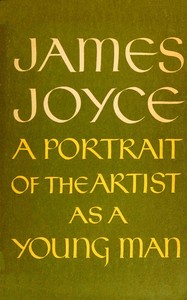
A Portrait of the Artist as a Young Man
James Joyce, 1916
A boy in Dublin grows up inside a family, a religion and a language, and tries to invent a self that none of them wrote for him.
 BookFeed
Pages from A Portrait of the Artist as a Young Man that stand on their own, chosen for how they read today. The text is in the public domain.
The moment beauty stops being an idea and stands in the water.
A girl stood before him in midstream, alone and still, gazing out to sea. She seemed like one whom magic had changed into the likeness of a strange and beautiful seabird. Her long slender bare legs were delicate as a crane’s and pure save where an emerald trail of seaweed had fashioned itself as a sign upon the flesh. Her thighs, fuller and softhued as ivory, were bared almost to the hips, where the white fringes of her drawers were like feathering of soft white down. Her slateblue skirts were kilted boldly about her waist and dovetailed behind her. Her bosom was as a bird’s, soft and slight, slight and soft as the breast of some darkplumaged dove. But her long fair hair was girlish: and girlish, and touched with the wonder of mortal beauty, her face. Ten years later, he still cannot stop rehearsing one tram ride.
He had written verses for her again after ten years. Ten years before she had worn her shawl cowlwise about her head, sending sprays of her warm breath into the night air, tapping her foot upon the glassy road. It was the last tram; the lank brown horses knew it and shook their bells to the clear night in admonition. The conductor talked with the driver, both nodding often in the green light of the lamp. They stood on the steps of the tram, he on the upper, she on the lower. She came up to his step many times between their phrases and went down again and once or twice remained beside him forgetting to go down and then went down. Let be! Let be! A small boy tries to work out what a kiss actually is.
The cold slime of the ditch covered his whole body; and, when the bell rang for study and the lines filed out of the playrooms, he felt the cold air of the corridor and staircase inside his clothes. He still tried to think what was the right answer. Was it right to kiss his mother or wrong to kiss his mother? What did that mean, to kiss? You put your face up like that to say goodnight and then his mother put her face down. That was to kiss. His mother put her lips on his cheek; her lips were soft and they wetted his cheek; and they made a tiny little noise: kiss. Why did people do that with their two faces? The moment devotion starts to feel like bookkeeping.
Every part of his day, divided by what he regarded now as the duties of his station in life, circled about its own centre of spiritual energy. His life seemed to have drawn near to eternity; every thought, word and deed, every instance of consciousness could be made to revibrate radiantly in heaven; and at times his sense of such immediate repercussion was so lively that he seemed to feel his soul in devotion pressing like fingers the keyboard of a great cash register and to see the amount of his purchase start forth immediately in heaven, not as a number but as a frail column of incense or as a slender flower. What it feels like to catch yourself becoming coarse.
As he walked home with silent companions a thick fog seemed to compass his mind. He waited in stupor of mind till it should lift and reveal what it had hidden. He ate his dinner with surly appetite and when the meal was over and the grease-strewn plates lay abandoned on the table, he rose and went to the window, clearing the thick scum from his mouth with his tongue and licking it from his lips. So he had sunk to the state of a beast that licks his chaps after meat. This was the end; and a faint glimmer of fear began to pierce the fog of his mind. He pressed his face against the pane of the window and gazed out into the darkening street. Forms passed this way and that through the dull light. And that was life. What happens when the rain outside stops being weather.
Rain was falling on the chapel, on the garden, on the college. It would rain forever, noiselessly. The water would rise inch by inch, covering the grass and shrubs, covering the trees and houses, covering the monuments and the mountain tops. All life would be choked off, noiselessly: birds, men, elephants, pigs, children: noiselessly floating corpses amid the litter of the wreckage of the world. Forty days and forty nights the rain would fall till the waters covered the face of the earth. What it means when the birds that nest in your eaves leave.
They came back with shrill cries over the jutting shoulder of the house, flying darkly against the fading air. What birds were they? He thought that they must be swallows who had come back from the south. Then he was to go away for they were birds ever going and coming, building ever an unlasting home under the eaves of men’s houses and ever leaving the homes they had built to wander. A physics lecture on a grey morning, and a mind leaving the room.
The formula which he wrote obediently on the sheet of paper, the coiling and uncoiling calculations of the professor, the spectrelike symbols of force and velocity fascinated and jaded Stephen’s mind. He had heard some say that the old professor was an atheist freemason. O the grey dull day! It seemed a limbo of painless patient consciousness through which souls of mathematicians might wander, projecting long slender fabrics from plane to plane of ever rarer and paler twilight, radiating swift eddies to the last verges of a universe ever vaster, farther and more impalpable. The kind of dream that has no story in it, only a room.
A long curving gallery. From the floor ascend pillars of dark vapours. It is peopled by the images of fabulous kings, set in stone. Their hands are folded upon their knees in token of weariness and their eyes are darkened for the errors of men go up before them forever as dark vapours. James Joyce, 1916
A boy in Dublin grows up inside a family, a religion and a language, and tries to invent a self that none of them wrote for him.
Read pages from books like this, one at a time
BookFeed is a feed of real passages from real books. It learns what moves you and finds your next book.
Open BookFeedFree, no sign-up.