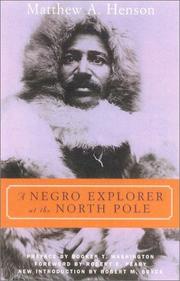
A Negro Explorer at the North Pole
Matthew Henson, 1912
A Black explorer's own account of the polar campaigns: hauling sledges, living as an Inuit among Inuit, and pushing north with Peary.
 BookFeed Ελληνικά
Pages from A Negro Explorer at the North Pole that stand on their own, chosen for how they read today. The text is in the public domain.
The kind of weather that makes shelter feel like a rumour.
Naturally there were frequent storms and intense cold, and in regard to the storms of the Arctic regions of North Greenland and Grant Land, the only word I can use to describe them is “terrible,” in the fullest meaning it conveys. The effect of such storms of wind and snow, or rain, is abject physical terror, due to the realization of perfect helplessness. I have seen rocks a hundred and a hundred and fifty pounds in weight picked up by the storm and blown for distances of ninety or a hundred feet to the edge of a precipice, and there of their own momentum go hurtling through space to fall in crashing fragments at the base. Imagine the effect of such a rainfall of death-dealing boulders on the feelings of a little group of three or four, who have sought the base of the cliff for shelter. The view from the last inhabited place before nothing.
I climbed to the highest pinnacle of the cape and in the gathering daylight gazed out over the ice-covered ocean to get an idea of its condition. At my back lay the land of sadness, just below me the little village of snow-houses, the northernmost city on the earth (Commander Peary give it the name Crane City), and, stretching wide and far to the northward, the irresistible influence that beckoned us on; broken ice, a sinister chaos, through which we would have to work our way. Dark and heavy clouds along the horizon gave indication of open water, and it was easy to see that the rough and heavy shore-ice would make no jokes for us to appreciate. Learning a language is easy; being adopted by its speakers is not.
Naturally the impressions formed on my first visit to the Land of Ice and Snow were the most lasting, but in the coming years I was to learn more and more that such a life was no picnic, and to realize what primitive life meant. I was to live with a people who, the scientists stated, represented the earliest form of human life, living in what is known as the Stone Age, and I was to revert to that stage of life by leaps and bounds, and to emerge from it by the same sudden means. Many and many a time, for periods covering more than twelve months, I have been to all intents an Eskimo, with Eskimos for companions, speaking their language, dressing in the same kind of clothes, living in the same kind of dens, eating the same food, enjoying their pleasures, and frequently sharing their griefs. A flag with pieces missing, each one left where someone got furthest.
This was a thin silk flag that Commander Peary had carried on all of his Arctic journeys, and he had always flown it at his last camps. It was as glorious and as inspiring a banner as any battle-scarred, bloodstained standard of the world—and this badge of honor and courage was also bloodstained and battle-scarred, for at several places there were blank squares marking the spots where pieces had been cut out at each of the “Farthests” of its brave bearer, and left with the records in the cairns, as mute but eloquent witnesses of his achievements. At the North Pole a diagonal strip running from the upper left to the lower right corner was cut and this precious strip, together with a brief record, was placed in an empty tin, sealed up and buried in the ice, as a record for all time. A census that only ever counts down.
It is my conviction that the life of this little tribe is doomed, and that extinction is nearly due. It will be caused partly by themselves, and partly by the misguided endeavors of civilized people. Every year their number diminishes; in 1894, Hugh J. Lee took the census of the tribe, and it numbered two hundred and fifty-three; in 1906, Professor Marvin found them to have dwindled to two hundred and seven. At this writing I dare say their number is still further reduced, for the latest news I have had from the Whale Sound region informs me that quite a number of deaths have occurred, and the birthrate is not high. It is sad to think of the fate of my friends who live in what was once a land of plenty, but which is, through the greed of the commercial hunter, becoming a land of frigid desolation. A ship's deck becomes a kingdom, decided in fifteen minutes of teeth.
Backward and forward, the foredeck of the ship was a howling, snarling, biting, yelping, moving mass of fury, and it was a long round of fully ten or fifteen minutes before the two king dogs of the packs got together, and then began the battle for supremacy of the pack. It lasted for some time. It would have been useless to separate them. They would decide sooner or later, and it was better to have it over, even if one or both contestants were killed. At length the fight was ended; our old king dog, Nalegaksoah, the champion of the pack, and the laziest dog in it, was still the king. After vanquishing his opponent and receiving humble acknowledgments, King Nalegaksoah went stamping up and down before the pack and received the homage due him; the new dogs, whining and fawning and cringingly submissive, bowed down before him. Nothing romantic survives contact with a team of half-wild dogs.
You take a piece of meat, frozen as stiff as a piece of sheet-iron, in one hand, and the harness in the other, you single out the cur you are after, make proper advances, and when he comes sniffling and snuffling and all the time keeping at a safe distance, you drop the sheet-iron on the snow, the brute makes a dive, and you make a flop, you grab the nearest thing grabable—ear, leg, or bunch of hair—and do your best to catch his throat, after which, everything is easy. Slip the harness over the head, push the forepaws through, and there you are, one dog hooked up and harnessed. After licking the bites and sucking the blood, you tie said dog to a rock and start for the next one. It is only a question of time before you have your team. There is a hunger that bread will never fix.
March 29: You have undoubtedly taken into consideration the pangs of hunger and of cold that you know assailed us, going Poleward; but have you ever considered that we were thirsty for water to drink or hungry for fat? To eat snow to quench our thirsts would have been the height of folly, and as well as being thirsty, we were continuously assailed by the pangs of a hunger that called for the fat, good, rich, oily, juicy fat that our systems craved and demanded. The goodbye he had rehearsed long before the boat left.
Goodbye all. Everyone is sending back a word to someone he has left behind, but I have said my goodbyes a long time ago, and as I waved my hand in parting salutation to the little group on the deck of the tug, my thoughts were with my wife, and I hoped when she next heard of me it would be with feelings of joy and happiness, and that she would be glad she had permitted me to leave her for an absence that might never end. The first sunrise after months of darkness.
March 5: A clear bright morning, 20° below zero; quite comfortable. Reached here yesterday at two-forty-five p.m., after some of the finest going I have ever seen. Commander Peary, Captain Bartlett, and Dr. Goodsell here, and fourteen Eskimos. First view of the sun today, for a few minutes at noon, makes us all cheerful. It was a crimson sphere, just balanced on the brink of the world. Had the weather been favorable, we could have seen the sun several days earlier. Every day following he will get higher and higher, until he finally swings around the sky above the horizon for the full twenty-four hours. Matthew Henson, 1912
A Black explorer's own account of the polar campaigns: hauling sledges, living as an Inuit among Inuit, and pushing north with Peary.
Read pages from books like this, one at a time
BookFeed is a feed of real passages from real books. It learns what moves you and finds your next book.
Open BookFeedFree, no sign-up.