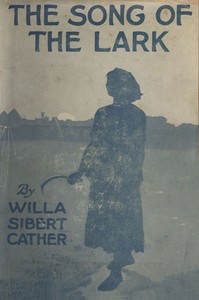
Το τραγούδι του κορυδαλλού
Willa Cather, 1915
Η κόρη ενός πάστορα από το Κολοράντο έχει φωνή που δεν χωρά στην πόλη της. Περνά είκοσι χρόνια προσπαθώντας να φύγει και ανακαλύπτει τι κοστίζει αυτό.
 BookFeed English
Σελίδες από το «Το τραγούδι του κορυδαλλού» που στέκονται μόνες τους, διαλεγμένες για το πώς διαβάζονται σήμερα. Το κείμενο ανήκει στο κοινό κτήμα.
Ο κόσμος μοιάζει έτοιμος να σου πάρει την καλύτερη στιγμή σου.
There was some power abroad in the world bent upon taking away from her that feeling with which she had come out of the concert hall. Everything seemed to sweep down on her to tear it out from under her cape. If one had that, the world became one’s enemy; people, buildings, wagons, cars, rushed at one to crush it under, to make one let go of it. Thea glared round her at the crowds, the ugly, sprawling streets, the long lines of lights, and she was not crying now. Her eyes were brighter than even Harsanyi had ever seen them. All these things and people were no longer remote and negligible; they had to be met, they were lined up against her, they were there to take something from her. Very well; they should never have it. They might trample her to death, but they should never have it. Η μέρα που ένας τόπος που αγαπάς γίνεται τόπος που θα αφήσεις.
On her thirteenth birthday she wandered for a long while about the sand ridges, picking up crystals and looking into the yellow prickly-pear blossoms with their thousand stamens. She looked at the sand hills until she wished she were a sand hill. And yet she knew that she was going to leave them all behind some day. They would be changing all day long, yellow and purple and lavender, and she would not be there. From that day on, she felt there was a secret between her and Wunsch. Together they had lifted a lid, pulled out a drawer, and looked at something. They hid it away and never spoke of what they had seen; but neither of them forgot it. Η παράξενη ανάλαφρη αίσθηση όταν επιτέλους φεύγεις.
But, of course, it was herself and her own adventure that mattered to her. If youth did not matter so much to itself, it would never have the heart to go on. Thea was surprised that she did not feel a deeper sense of loss at leaving her old life behind her. It seemed, on the contrary, as she looked out at the yellow desert speeding by, that she had left very little. Everything that was essential seemed to be right there in the car with her. She lacked nothing. She even felt more compact and confident than usual. She was all there, and something else was there, too—in her heart, was it, or under her cheek? Anyhow, it was about her somewhere, that warm sureness, that sturdy little companion with whom she shared a secret. Ένας πίνακας σου δείχνει τι θέλεις πριν μπορέσεις να το πεις.
That was a picture indeed. She liked even the name of it, “The Song of the Lark.” The flat country, the early morning light, the wet fields, the look in the girl’s heavy face—well, they were all hers, anyhow, whatever was there. She told herself that that picture was “right.” Just what she meant by this, it would take a clever person to explain. But to her the word covered the almost boundless satisfaction she felt when she looked at the picture. Η μουσική που σου ξαναφέρνει τις πεδιάδες απ’ όπου ήρθες.
When the first movement ended, Thea’s hands and feet were cold as ice. She was too much excited to know anything except that she wanted something desperately, and when the English horns gave out the theme of the Largo, she knew that what she wanted was exactly that. Here were the sand hills, the grasshoppers and locusts, all the things that wakened and chirped in the early morning; the reaching and reaching of high plains, the immeasurable yearning of all flat lands. There was home in it, too; first memories, first mornings long ago; the amazement of a new soul in a new world; a soul new and yet old, that had dreamed something despairing, something glorious, in the dark before it was born; a soul obsessed by what it did not know, under the cloud of a past it could not recall. Η πρώτη ζεστή εβδομάδα, όταν η πόλη βγάζει τα παράθυρα.
It was in the summer that one really lived. Then all the little overcrowded houses were opened wide, and the wind blew through them with sweet, earthy smells of garden-planting. The town looked as if it had just been washed. People were out painting their fences. The cottonwood trees were a-flicker with sticky, yellow little leaves, and the feathery tamarisks were in pink bud. With the warm weather came freedom for everybody. People were dug up, as it were. The very old people, whom one had not seen all winter, came out and sunned themselves in the yard. The double windows were taken off the houses, the tormenting flannels in which children had been encased all winter were put away in boxes, and the youngsters felt a pleasure in the cool cotton things next their skin. Σε μια μικρή πόλη, οι γνώμες των γειτόνων προηγούνται των δικών σου.
This argument conquered Thea, though she left the table sullenly. The fear of the tongue, that terror of little towns, is usually felt more keenly by the minister’s family than by other households. Whenever the Kronborgs wanted to do anything, even to buy a new carpet, they had to take counsel together as to whether people would talk. Mrs. Kronborg had her own conviction that people talked when they felt like it, and said what they chose, no matter how the minister’s family conducted themselves. But she did not impart these dangerous ideas to her children. Thea was still under the belief that public opinion could be placated; that if you clucked often enough, the hens would mistake you for one of themselves. Τι σημαίνει να κολυμπάς σε νερό που έχει επιζήσει από όλους.
When Thea took her bath at the bottom of the canyon, in the sunny pool behind the screen of cottonwoods, she sometimes felt as if the water must have sovereign qualities, from having been the object of so much service and desire. That stream was the only living thing left of the drama that had been played out in the canyon centuries ago. In the rapid, restless heart of it, flowing swifter than the rest, there was a continuity of life that reached back into the old time. The glittering thread of current had a kind of lightly worn, loosely knit personality, graceful and laughing. Thea’s bath came to have a ceremonial gravity. The atmosphere of the canyon was ritualistic. Κάθε πόλη έχει δύο πληθυσμούς, μα μόνο ο ένας είναι ξύπνιος.
The rich, noisy, city, fat with food and drink, is a spent thing; its chief concern is its digestion and its little game of hide-and-seek with the undertaker. Money and office and success are the consolations of impotence. Fortune turns kind to such solid people and lets them suck their bone in peace. She flecks her whip upon flesh that is more alive, upon that stream of hungry boys and girls who tramp the streets of every city, recognizable by their pride and discontent, who are the Future, and who possess the treasure of creative power. Willa Cather, 1915
Η κόρη ενός πάστορα από το Κολοράντο έχει φωνή που δεν χωρά στην πόλη της. Περνά είκοσι χρόνια προσπαθώντας να φύγει και ανακαλύπτει τι κοστίζει αυτό.
Διάβασε σελίδες από βιβλία σαν αυτό, μία τη φορά
Το BookFeed είναι μια ροή με αποσπάσματα από βιβλία. Μαθαίνει τι σου αρέσει και σε βοηθά να βρεις το επόμενο βιβλίο σου.
Άνοιξε το BookFeedΔωρεάν, χωρίς εγγραφή.