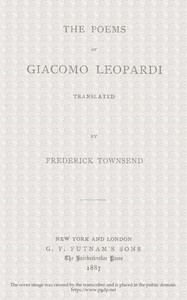
Τα ποιήματα
Giacomo Leopardi, 1819
Ποίηση που αποτυπώνει την τρομερή ομορφιά και το ασήκωτο βάρος της ύπαρξης, διαγράφοντας τη διαδρομή από την εξιδανικευμένη ελπίδα της νιότης ως την αποδοχή της καθολικής μελαγχολίας.
 BookFeed English
Σελίδες από το «Τα ποιήματα» που στέκονται μόνες τους, διαλεγμένες για το πώς διαβάζονται σήμερα. Το κείμενο ανήκει στο κοινό κτήμα.
Η παύση κάθε αισθήματος παρουσιάζεται ως η μόνη ανακούφιση από το βάρος της ζωής.
Nor wilt thou rest forever, weary heart.The last illusion is destroyed,That I eternal thought. Destroyed!I feel all hope and all desire depart,For life and its deceitful joys.Forever rest! Enough! Thy throbbings cease!Naught can requite thy miseries;Nor is earth worthy of thy sighs.Life is a bitter, weary load,The world a slough. And now, repose!Despair no more, but find in DeathThe only boon Fate on our race bestows! Το ιταλικό τραγούδι γεννιέται από έναν συγκεκριμένο, αβάσταχτο πόνο.
Thy holy ashes still were warm,Whom hostile fortune ne’er unmanned;Unto whose anger and whose grief,Hell was more grateful than thy native land.Ah, what, but hell, has Italy become?And thy sweet cordsStill trembled at the touch of thy right hand,Unhappy bard of love.Alas, Italian song is still the childOf sorrow born.And yet, less hard to bear,Consuming grief than dull vacuity! Ένα πρόσωπο που κρατά τη μνήμη μπορεί μόνο να βλέπει τον χρόνο να περνά.
Such wast thou: now in earth below,Dust and a skeleton thou art.Above thy bones and clay,Here vainly placed by loving hands,Sole guardian of memory and woe,The image of departed beauty stands.Mute, motionless, it seems with pensive gazeTo watch the flight of the departing days.That gentle look, that, wheresoe’er it fell,As now it seems to fall,Held fast the gazer with its magic spell;That lip, from which as from some copious urn,Redundant pleasure seems to overflow;That neck, on which love once so fondly hung; Τα όμορφα φανταστικά όνειρα σβήνουν μπροστά στην ψυχρή πραγματικότητα.
But thou for these sweet dreams wast born,And the old sun upon thee shone,Delightful singer of the arms, and loves,That in an age far happier than our own,Men’s lives with pleasing errors filled.New hope of Italy! O towers, O caves,O ladies, cavaliers,O gardens, palaces! Amenites,At thought of which, the mindIs lost in thousand splendid reveries!Ye lovely fables, and ye thoughts grotesque,Now banished! And what to us remains?Now that the bloom from all things is removed? Η νιότη και οι απολαύσεις δεν γλιτώνουν κανέναν από την αιώνια ανία.
Another gives his nights and days to games,And feasts, and dances with the reigning belles:A smile perpetual is on his lips;But in his breast, alas, stern and severe,Like adamantine column motionless,Eternal ennui sits, against whose mightAvail not vigorous youth, nor prattle fondThat falls from rosy lips, nor tender glanceThat trembles in two dark and lustrous eyes;The most bewildering of mortal things,Most precious gift of heaven unto man. Ένας βοσκός ρωτά το φεγγάρι αν δεν κουράζεται να επαναλαμβάνει την ίδια πορεία.
What doest thou in heaven, O moon?Say, silent moon, what doest thou?Thou risest in the evening; thoughtfullyThou wanderest o’er the plain,Then sinkest to thy rest again.And art thou never satisfiedWith going o’er and o’er the selfsame ways?Art never wearied? Dost thou stillUpon these valleys love to gaze?How much thy life is likeThe shepherd’s life, forlorn!He rises in the early dawn,He moves his flock along the plain; Ακόμα κι η όχθη δεν τον αφήνει να σταθεί κοντά της.
To thy proud realms, O Nature, I, a poor,Unwelcome guest, rejected lover, come;To all thy varied forms of loveliness,My heart and eyes, a suppliant, lift in vain.The sun-lit shore hath smiles no more for me,Nor radiant morning light at heaven’s gate;The birds no longer greet me with their songs,Nor whispering trees with gracious messages;And where, beneath the bending willows’ shade,The limpid stream its bosom pure displays,As I, with trembling and uncertain foot,Oppressed with grief, upon its margin pause,The dimpled waves recoil, as in disdain,And urge their flight along the flowery plain. Η εποχή λατρεύει σήμερα όσα περιφρονούσε χτες και αύριο θα γκρεμίσει πάλι.
O minds, O wisdom, insight marvellousOf this our passing age! And what profoundPhilosophy, what lessons deep, O Gino,In matters more sublime and recondite,This century of thine and mine will teachTo those that follow! With what constancy,What yesterday it scorned, upon its kneesTo-day it worships, and will overthrowTo-morrow, merely to pick up againThe fragments, to the idol thus restored,To offer incense on the following day!How estimable, how inspiring, too,This unanimity of thought, not ofThe age alone, but of each passing year! Giacomo Leopardi, 1819
Ποίηση που αποτυπώνει την τρομερή ομορφιά και το ασήκωτο βάρος της ύπαρξης, διαγράφοντας τη διαδρομή από την εξιδανικευμένη ελπίδα της νιότης ως την αποδοχή της καθολικής μελαγχολίας.
Διάβασε σελίδες από βιβλία σαν αυτό, μία τη φορά
Το BookFeed είναι μια ροή με αποσπάσματα από βιβλία. Μαθαίνει τι σου αρέσει και σε βοηθά να βρεις το επόμενο βιβλίο σου.
Άνοιξε το BookFeedΔωρεάν, χωρίς εγγραφή.