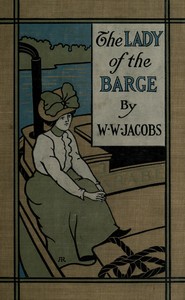
The Lady of the Barge
W. W. Jacobs, 1902
Σύντομες, νευρικές ιστορίες από την Εδουαρδιανή Αγγλία: ένα καταραμένο πέλμα, μια τίγρη που κυκλοφορεί ελεύθερη σ’ ένα χωριό και άντρες που φέρονται άσχημα — πρώτα γελάς, ύστερα παγώνεις.
 BookFeed English
Σελίδες από το «The Lady of the Barge» που στέκονται μόνες τους, διαλεγμένες για το πώς διαβάζονται σήμερα. Το κείμενο ανήκει στο κοινό κτήμα.
Το πρωινό φως δεν διώχνει τη νύχτα από το σπίτι.
Long before anybody else was astir he arose and stole softly downstairs. The sunlight was stealing in at every crevice, and flashing in long streaks across the darkened rooms. The dining-room into which he looked struck chill and cheerless in the dark yellow light which came through the lowered blinds. He remembered that it had the same appearance when his father lay dead in the house; now, as then, everything seemed ghastly and unreal; the very chairs standing as their occupants had left them the night before seemed to be indulging in some dark communication of ideas. Το αίμα ανεβαίνει, τα νεύρα τεντώνονται και κάποιος ακούει από κάτω.
At this Mrs. Gibbs’s temper, which had been rising, gave way altogether, and she stamped fiercely upon the deck. A stamp of the foot has been for all time a rough-and-ready means of signalling; the fore-scuttle was drawn back, and the face of a young and pretty girl appeared framed in the opening. The mate raised his eyebrows with a helpless gesture, and as for the unfortunate skipper, any jury would have found him guilty without leaving the box. The wife of his bosom, with a flaming visage, turned and regarded him. Ο φίλος σου ντύνεται σαν να ετοιμάζεται για κάτι σημαντικό.
The Major looked at him, and for the first time noticed an unusual neatness and dressiness in his friend’s attire. His collar was higher than usual; his tie, of the whitest and finest silk, bore a pin he never remembered to have seen before; and for the first time since he had known him, the Major, with a strange sinking at the heart, saw that he wore spats. Ένα ξεχασμένο πηγάδι μένει πάντα στη σκιά.
The well, which had long ago fallen into disuse, was almost hidden by the thick tangle of undergrowth which ran riot at that corner of the old park. It was partly covered by the shrunken half of a lid, above which a rusty windlass creaked in company with the music of the pines when the wind blew strongly. The full light of the sun never reached it, and the ground surrounding it was moist and green when other parts of the park were gaping with the heat. Η τίγρη θα φάει μόνο έναν, λέει ο Σμιθ.
“Up to ten o’clock we did very well, and then Smith began to talk about ’is license. He said it was all rubbish being afraid to go ’ome, and that, at any rate, the tiger couldn’t eat more than one of us, and while ’e was doing that there was the chance for the others to get ’ome safe. Two or three of ’em took a dislike to Smith that night and told ’im so. Έχουν στρώσει για τρεις, μα σβήνουν τα κεριά πριν φάνε.
“As he spoke the old woman entered, and, eyeing me stealthily, began to lay the cloth, while my host, taking a chair the other side of the hearth, sat looking silently into the fire. The table set, the old woman brought in a pair of fowls ready carved in a dish, and placing three chairs, left the room. The old man hesitated a moment, and then, rising from his chair, placed a large screen in front of the fire and slowly extinguished the candles. Μέσα, η φωτιά καίει· έξω, η νύχτα είναι κρύα και υγρή.
Without, the night was cold and wet, but in the small parlour of Laburnam Villa the blinds were drawn and the fire burned brightly. Father and son were at chess, the former, who possessed ideas about the game involving radical changes, putting his king into such sharp and unnecessary perils that it even provoked comment from the white-haired old lady knitting placidly by the fire. Δεν μιλούν, αλλά η συζήτηση ανάμεσά τους συνεχίζεται.
He broke off and eyed with dignified surprise a fine piece of wireless telegraphy between husband and wife. It appeared that Mr. Negget sent off a humorous message with his left eye, the right being for some reason closed, to which Mrs. Negget replied with a series of frowns and staccato shakes of the head, which her husband found easily translatable. Under the austere stare of Mr. Bodfish their faces at once regained their wonted calm, and the ex-constable in a somewhat offended manner resumed his inquiries. Η νοσοκόμα καταφτάνει και πρώτα ταρακουνά τα μαξιλάρια.
The assistance arrived late in the day in the shape of an elderly woman, whose Spartan treatment of her patients had helped many along the silent road. She commenced her reign by punching the sick man’s pillows, and having shaken him into consciousness by this means, gave him a dose of physic, after first tasting it herself from the bottle. W. W. Jacobs, 1902
Σύντομες, νευρικές ιστορίες από την Εδουαρδιανή Αγγλία: ένα καταραμένο πέλμα, μια τίγρη που κυκλοφορεί ελεύθερη σ’ ένα χωριό και άντρες που φέρονται άσχημα — πρώτα γελάς, ύστερα παγώνεις.
Διάβασε σελίδες από βιβλία σαν αυτό, μία τη φορά
Το BookFeed είναι μια ροή με αποσπάσματα από βιβλία. Μαθαίνει τι σου αρέσει και σε βοηθά να βρεις το επόμενο βιβλίο σου.
Άνοιξε το BookFeedΔωρεάν, χωρίς εγγραφή.