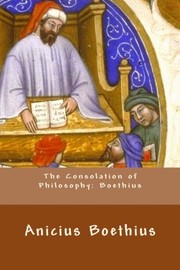
The Consolation of Philosophy
Boethius, 524
Ένας φυλακισμένος που περιμένει την εκτέλεσή του συζητά με τη Φιλοσοφία για το γιατί ευημερούν οι άδικοι και για το αν ήταν ποτέ δικά μας όσα χάνουμε. Το έργο έμαθε στον Μεσαίωνα πώς να θρηνεί.
 BookFeed English
Σελίδες από το «The Consolation of Philosophy» που στέκονται μόνες τους, διαλεγμένες για το πώς διαβάζονται σήμερα. Το κείμενο ανήκει στο κοινό κτήμα.
Η αναξιοπιστία υπερασπίζεται τον εαυτό της.
Am I alone to be forbidden to do what I will with my own? Unrebuked, the skies now reveal the brightness of day, now shroud the daylight in the darkness of night; the year may now engarland the face of the earth with flowers and fruits, now disfigure it with storms and cold. The sea is permitted to invite with smooth and tranquil surface today, tomorrow to roughen with wave and storm. Shall man’s insatiate greed bind me to a constancy foreign to my character? This is my art, this the game I never cease to play. I turn the wheel that spins. I delight to see the high come down and the low ascend. Mount up, if thou wilt, but only on condition that thou wilt not think it a hardship to come down when the rules of my game require it. Wert thou ignorant of my character? Τι σημαίνει στ’ αλήθεια το «για πάντα» και γιατί δεν είναι απλώς πολύς χρόνος;
“God is eternal; in this judgment all rational beings agree. Let us, then, consider what eternity is. For this word carries with it a revelation alike of the Divine nature and of the Divine knowledge. Now, eternity is the possession of endless life whole and perfect at a single moment. What this is becomes more clear and manifest from a comparison with things temporal. For whatever lives in time is a present proceeding from the past to the future, and there is nothing set in time which can embrace the whole space of its life together. Tomorrow’s state it grasps not yet, while it has already lost yesterday’s; nay, even in the life of today ye live no longer than one brief transitory moment. Σε αφήνει κάποιος που ήξερες πως δεν θα μείνει.
“What is it, then, poor mortal, that hath cast thee into lamentation and mourning? Some strange, unwonted sight, methinks, have thine eyes seen. Thou deemest Fortune to have changed towards thee; thou mistakest. Such ever were her ways, ever such her nature. Rather in her very mutability hath she preserved towards thee her true constancy. Such was she when she loaded thee with caresses, when she deluded thee with the allurements of a false happiness. Thou hast found out how changeful is the face of the blind goddess. She who still veils herself from others hath fully discovered to thee her whole character. If thou likest her, take her as she is, and do not complain. If thou abhorrest her perfidy, turn from her in disdain, renounce her, for baneful are her delusions. Το μόνο που δεν μπορεί να σου πάρει η Τύχη είναι ήδη δικό σου.
“Why, then, ye children of mortality, seek ye from without that happiness whose seat is only within us? Error and ignorance bewilder you. I will show thee, in brief, the hinge on which perfect happiness turns. Is there anything more precious to thee than thyself? Nothing, thou wilt say. If, then, thou art master of thyself, thou wilt possess that which thou wilt never be willing to lose, and which Fortune cannot take from thee. Αυτός που κατηγορείται είναι εκείνος που αξίζει τον οίκτο σου.
“And yet,” says she, “the practice of the law courts is just the opposite: advocates try to arouse the commiseration of the judges for those who have endured some grievous and cruel wrong; whereas pity is rather due to the criminal, who ought to be brought to the judgment seat by his accusers in a spirit not of anger, but of compassion and kindness, as a sick man to the physician, to have the ulcer of his fault cut away by punishment. Whereby the business of the advocate would either wholly come to a standstill, or, did men prefer to make it serviceable to mankind, would be restricted to the practice of accusation. Σε τι μεταμορφωνόμαστε όταν παίρνουμε αυτό που θέλουμε;
“See, also, from the opposite standpoint—the standpoint of the good—what a penalty attends upon the wicked. Thou didst learn a little since that whatever is is one, and that unity itself is good. Accordingly, by this way of reckoning, whatever falls away from goodness ceases to be; whence it comes to pass that the bad cease to be what they were, while only the outward aspect is still left to show they have been men. Wherefore, by their perversion to badness, they have lost their true human nature. Further, since righteousness alone can raise men above the level of humanity, it must needs be that unrighteousness degrades below man’s level those whom it has cast out of man’s estate. It results, then, that thou canst not consider him human whom thou seest transformed by vice. The violent despoiler of other men’s goods, enflamed with covetousness, surely resembles a wolf. Τι μπορεί να σου μάθει μια χρονιά που πήγε στραβά;
“But that thou mayst not think that I wage implacable warfare against Fortune, I own there is a time when the deceitful goddess serves men well—I mean when she reveals herself, uncovers her face, and confesses her true character. Perhaps thou dost not yet grasp my meaning. Strange is the thing I am trying to express, and for this cause I can scarce find words to make clear my thought. For truly I believe that Ill Fortune is of more use to men than Good Fortune. For Good Fortune, when she wears the guise of happiness, and most seems to caress, is always lying; Ill Fortune is always truthful, since, in changing, she shows her inconstancy. Πόσο μακριά μπορεί να πέσει ένας νους από όσα κάποτε καταλάβαινε;
Alas! in what abyss his mindIs plunged, how wildly tossed!Still, still towards the outer nightShe sinks, her true light lost,As oft as, lashed tumultuouslyBy earthborn blasts, care’s waves rise high.Yet once he ranged the open heavens,The sun’s bright pathway tracked;Watched how the cold moon waxed and waned;Nor rested, till there lackedTo his wide ken no star that steersAmid the maze of circling spheres. Πώς ψάχνεις κάτι που δεν μπορείς να ονομάσεις;
Ah! then why burns man’s restless mindTruth’s hidden portals to unclose?Knows he already what he seeks?Why toil to seek it, if he knows?Yet, haply if he knoweth not,Why blindly seek he knows not what?Who for a good he knows not sighs?Who can an unknown end pursue?How find? How e’en when haply foundHail that strange form he never knew?Or is it that man’s inmost soulOnce knew each part and knew the whole? Πώς ξεχωρίζεις τον φιλόσοφο από εκείνον που παριστάνει τον φιλόσοφο;
Let me tell thee how wittily one did mock the shallowness of this sort of arrogance. A certain man assailed one who had put on the name of philosopher as a cloak to pride and vainglory, not for the practice of real virtue, and added: ‘Now shall I know if thou art a philosopher if thou bearest reproaches calmly and patiently.’ The other for awhile affected to be patient, and, having endured to be abused, cried out derisively: ‘Now, do you see that I am a philosopher?’ The other, with biting sarcasm, retorted: ‘I should have hadst thou held thy peace.’ Boethius, 524
Ένας φυλακισμένος που περιμένει την εκτέλεσή του συζητά με τη Φιλοσοφία για το γιατί ευημερούν οι άδικοι και για το αν ήταν ποτέ δικά μας όσα χάνουμε. Το έργο έμαθε στον Μεσαίωνα πώς να θρηνεί.
Διάβασε σελίδες από βιβλία σαν αυτό, μία τη φορά
Το BookFeed είναι μια ροή με αποσπάσματα από βιβλία. Μαθαίνει τι σου αρέσει και σε βοηθά να βρεις το επόμενο βιβλίο σου.
Άνοιξε το BookFeedΔωρεάν, χωρίς εγγραφή.