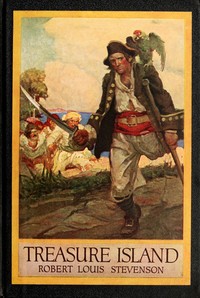
Treasure Island
Robert Louis Stevenson, 1883
A boy finds a dead sailor's map and ends up aboard a ship where the friendliest man may be the most dangerous. Fast, funny, and the template for pirate stories.
 BookFeed Ελληνικά
Pages from Treasure Island that stand on their own, chosen for how they read today. The text is in the public domain.
Three crosses in red ink, and four words beside one of them.
The doctor opened the seals with great care, and there fell out the map of an island, with latitude and longitude, soundings, names of hills and bays and inlets, and every particular that would be needed to bring a ship to a safe anchorage upon its shores. It was about nine miles long and five across, shaped, you might say, like a fat dragon standing up, and had two fine land-locked harbours, and a hill in the centre part marked “The Spy-glass.” There were several additions of a later date, but above all, three crosses of red ink—two on the north part of the island, one in the southwest—and beside this last, in the same red ink, and in a small, neat hand, very different from the captain’s tottery characters, these words: “Bulk of treasure here.” Sunshine, birdsong, land at last, and a dread that arrives anyway.
Perhaps it was this—perhaps it was the look of the island, with its grey, melancholy woods, and wild stone spires, and the surf that we could both see and hear foaming and thundering on the steep beach—at least, although the sun shone bright and hot, and the shore birds were fishing and crying all around us, and you would have thought anyone would have been glad to get to land after being so long at sea, my heart sank, as the saying is, into my boots; and from the first look onward, I hated the very thought of Treasure Island. A one-legged cook so cheerful you almost forget to wonder.
As I was waiting, a man came out of a side room, and at a glance I was sure he must be Long John. His left leg was cut off close by the hip, and under the left shoulder he carried a crutch, which he managed with wonderful dexterity, hopping about upon it like a bird. He was very tall and strong, with a face as big as a ham—plain and pale, but intelligent and smiling. Indeed, he seemed in the most cheerful spirits, whistling as he moved about among the tables, with a merry word or a slap on the shoulder for the more favoured of his guests. What the open sea looks like once you are inside it.
I found each wave, instead of the big, smooth glossy mountain it looks from shore or from a vessel’s deck, was for all the world like any range of hills on dry land, full of peaks and smooth places and valleys. The coracle, left to herself, turning from side to side, threaded, so to speak, her way through these lower parts and avoided the steep slopes and higher, toppling summits of the wave. Health, appetite, sleep, and still no peace until the ship sails.
I am in the most magnificent health andspirits, eating like a bull, sleeping like a tree,yet I shall not enjoy a moment till I hear my oldtarpaulins tramping round the capstan. Seaward,ho! Hang the treasure! It’s the glory of the seathat has turned my head. So now, Livesey, comepost; do not lose an hour, if you respect me. Idle scribbles in a dead man's book, and one word that itches.
The squire and I were both peering over his shoulder as he opened it, for Dr. Livesey had kindly motioned me to come round from the side-table, where I had been eating, to enjoy the sport of the search. On the first page there were only some scraps of writing, such as a man with a pen in his hand might make for idleness or practice. One was the same as the tattoo mark, “Billy Bones his fancy”; then there was “Mr. W. Bones, mate,” “No more rum,” “Off Palm Key he got itt,” and some other snatches, mostly single words and unintelligible. I could not help wondering who it was that had “got itt,” and what “itt” was that he got. A knife in his back as like as not. What a hard man's face does when the past walks in.
The captain spun round on his heel and fronted us; all the brown had gone out of his face, and even his nose was blue; he had the look of a man who sees a ghost, or the evil one, or something worse, if anything can be; and upon my word, I felt sorry to see him all in a moment turn so old and sick. A ship so well provisioned that contentment starts to look suspicious.
We had some heavy weather, which only proved the qualities of the HISPANIOLA. Every man on board seemed well content, and they must have been hard to please if they had been otherwise, for it is my belief there was never a ship’s company so spoiled since Noah put to sea. Double grog was going on the least excuse; there was duff on odd days, as, for instance, if the squire heard it was any man’s birthday, and always a barrel of apples standing broached in the waist for anyone to help himself that had a fancy. A lodger who changes nothing, and keeps one thing shut.
All the time he lived with us the captain made no change whatever in his dress but to buy some stockings from a hawker. One of the cocks of his hat having fallen down, he let it hang from that day forth, though it was a great annoyance when it blew. I remember the appearance of his coat, which he patched himself upstairs in his room, and which, before the end, was nothing but patches. He never wrote or received a letter, and he never spoke with any but the neighbours, and with these, for the most part, only when drunk on rum. The great sea-chest none of us had ever seen open. Robert Louis Stevenson, 1883
A boy finds a dead sailor's map and ends up aboard a ship where the friendliest man may be the most dangerous. Fast, funny, and the template for pirate stories.
Read pages from books like this, one at a time
BookFeed is a feed of real passages from real books. It learns what moves you and finds your next book.
Open BookFeedFree, no sign-up.