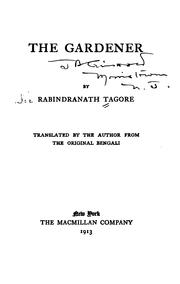
The gardener
Rabindranath Tagore, 1913
Fifty-odd small songs about love, parting, gardens and God, in the plain English prose the poet made himself, from the Bengali originals.
 BookFeed Ελληνικά
Pages from The gardener that stand on their own, chosen for how they read today. The text is in the public domain.
A man decides to leave his family for God, and God quietly objects.
At midnight the would-be ascetic announced:“This is the time to give up my home and seek for God. Ah, whohas held me so long in delusion here?”God whispered, “I,” but the ears of the man were stopped.With a baby asleep at her breast lay his wife, peacefullysleeping on one side of the bed.The man said, “Who are ye that have fooled me so long?”The voice said again, “They are God,” but he heard it not.The baby cried out in its dream, nestling close to its mother.God commanded, “Stop, fool, leave not thy home,” but still heheard not.God sighed and complained, “Why does my servant wander to seekme, forsaking me?” A writer addresses you directly, knowing he will never meet you.
Who are you, reader, reading my poems an hundred years hence?I cannot send you one single flower from this wealth of thespring, one single streak of gold from yonder clouds.Open your doors and look abroad.From your blossoming garden gather fragrant memories of thevanished flowers of an hundred years before.In the joy of your heart may you feel the living joy that sangone spring morning, sending its glad voice across an hundredyears. The tenderness you're proudest of may be the thing that smothers.
Why did the lamp go out?I shaded it with my cloak to save it from the wind, that is whythe lamp went out.Why did the flower fade?I pressed it to my heart with anxious love, that is why theflower faded.Why did the stream dry up?I put a dam across it to have it for my use, that is why thestream dried up. Why the truest thing you have to say comes out as a joke.
I long to speak the deepest words I have to say to you; but Idare not, for fear you should laugh.That is why I laugh at myself and shatter my secret in jest.I make light of my pain, afraid you should do so.I long to tell you the truest words I have to say to you; but Idare not, being afraid that you would not believe them.That is why I disguise them in untruth, saying the contrary ofwhat I mean.I make my pain appear absurd, afraid that you should do so. What it would take to make a goodbye feel finished rather than cut off.
Peace, my heart, let the time for the parting be sweet.Let it not be a death but completeness.Let love melt into memory and pain into songs.Let the flight through the sky end in the folding of the wingsover the nest.Let the last touch of your hands be gentle like the flower of thenight.Stand still, O Beautiful End, for a moment, and say your lastwords in silence.I bow to you and hold up my lamp to light you on your way. A whole crowd's happiness measured against one child who has nothing to spend.
The fair was on before the temple. It had rained from the earlymorning and the day came to its end.Brighter than all the gladness of the crowd was the bright smileof a girl who bought for a farthing a whistle of palm leaf.The shrill joy of that whistle floated above all laughter andnoise.An endless throng of people came and jostled together. The roadwas muddy, the river in flood, the field under water inceaseless rain.Greater than all the troubles of the crowd was a little boy’strouble—he had not a farthing to buy a painted stick.His wistful eyes gazing at the shop made this whole meeting ofmen so pitiful. The treasure that arrives disguised as an ordinary day.
One day a village boy came up and asked, “Tell me, where did youcome at this golden chain about your waist?”The madman started—the chain that once was iron was verily gold;it was not a dream, but he did not know when it had changed.He struck his forehead wildly—where, O where had he withoutknowing it achieved success?It had grown into a habit, to pick up pebbles and touch thechain, and to throw them away without looking to see if achange had come; thus the madman found and lost the touchstone.The sun was sinking low in the west, the sky was of gold.The madman returned on his footsteps to seek anew the losttreasure, with his strength gone, his body bent, and his heartin the dust, like a tree uprooted. Two birds love each other; each one's idea of home is the other's prison.
The tame bird was in a cage, the free bird was in the forest.They met when the time came, it was a decree of fate.The free bird cries, “O my love, let us fly to wood.”The cage bird whispers, “Come hither, let us both live in thecage.”Says the free bird, “Among bars, where is there room to spreadone’s wings?”“Alas,” cries the cage bird, “I should not know where to sitperched in the sky.” A gift whose beauty only the giver cannot see.
One morning in the flower garden a blind girl came to offer me aflower chain in the cover of a lotus leaf.I put it round my neck, and tears came to my eyes.I kissed her and said, “You are blind even as the flowers are.You yourself know not how beautiful is your gift.” Rabindranath Tagore, 1913
Fifty-odd small songs about love, parting, gardens and God, in the plain English prose the poet made himself, from the Bengali originals.
Read pages from books like this, one at a time
BookFeed is a feed of real passages from real books. It learns what moves you and finds your next book.
Open BookFeedFree, no sign-up.