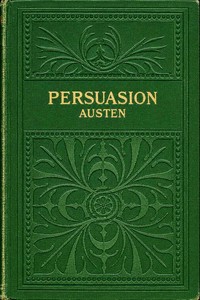
Persuasion
Jane Austen, 1817
A woman of twenty-seven meets again the man she was talked out of marrying, and begins to wonder whether prudence was ever a virtue.
 BookFeed Ελληνικά
Pages from Persuasion that stand on their own, chosen for how they read today. The text is in the public domain.
The particular loneliness of a room shared with someone you once loved.
They had no conversation together, no intercourse but what the commonest civility required. Once so much to each other! Now nothing! There had been a time, when of all the large party now filling the drawing-room at Uppercross, they would have found it most difficult to cease to speak to one another. With the exception, perhaps, of Admiral and Mrs. Croft, who seemed particularly attached and happy (Anne could allow no other exception even among the married couples), there could have been no two hearts so open, no tastes so similar, no feelings so in unison, no countenances so beloved. Now they were as strangers; nay, worse than strangers, for they could never become acquainted. It was a perpetual estrangement. The guilt of being happy when you have no right to be.
No, it was not regret which made Anne’s heart beat in spite of herself, and brought the colour into her cheeks when she thought of Captain Wentworth unshackled and free. She had some feelings which she was ashamed to investigate. They were too much like joy, senseless joy! The caution of youth, and the romance that comes too late.
How eloquent could Anne Elliot have been! how eloquent, at least, were her wishes on the side of early warm attachment, and a cheerful confidence in futurity, against that overanxious caution which seems to insult exertion and distrust Providence! She had been forced into prudence in her youth, she learned romance as she grew older: the natural sequel of an unnatural beginning. The advice we give most fluently is the advice we never take.
When the evening was over, Anne could not but be amused at the idea of her coming to Lyme to preach patience and resignation to a young man whom she had never seen before; nor could she help fearing, on more serious reflection, that, like many other great moralists and preachers, she had been eloquent on a point in which her own conduct would ill bear examination. The polished people who never slip are the ones to watch.
Mr. Elliot was rational, discreet, polished, but he was not open. There was never any burst of feeling, any warmth of indignation or delight, at the evil or good of others. This, to Anne, was a decided imperfection. Her early impressions were incurable. She prized the frank, the openhearted, the eager character beyond all others. Warmth and enthusiasm did captivate her still. She felt that she could so much more depend upon the sincerity of those who sometimes looked or said a careless or a hasty thing, than of those whose presence of mind never varied, whose tongue never slipped. Why we expect grief to look graceful, and what that expectation costs.
Personal size and mental sorrow have certainly no necessary proportions. A large bulky figure has as good a right to be in deep affliction, as the most graceful set of limbs in the world. But, fair or not fair, there are unbecoming conjunctions, which reason will patronize in vain—which taste cannot tolerate—which ridicule will seize. The case for being persuadable, from someone who was persuaded.
Anne wondered whether it ever occurred to him now, to question the justness of his own previous opinion as to the universal felicity and advantage of firmness of character; and whether it might not strike him that, like all other qualities of the mind, it should have its proportions and limits. She thought it could scarcely escape him to feel that a persuadable temper might sometimes be as much in favour of happiness as a very resolute character. A parlour rearranged by young women, and the ancestors staring in disbelief.
To the Great House accordingly they went, to sit the full half hour in the old-fashioned square parlour, with a small carpet and shining floor, to which the present daughters of the house were gradually giving the proper air of confusion by a grand pianoforte and a harp, flower-stands and little tables placed in every direction. Oh! could the originals of the portraits against the wainscot, could the gentlemen in brown velvet and the ladies in blue satin have seen what was going on, have been conscious of such an overthrow of all order and neatness! The portraits themselves seemed to be staring in astonishment. Jane Austen, 1817
A woman of twenty-seven meets again the man she was talked out of marrying, and begins to wonder whether prudence was ever a virtue.
Read pages from books like this, one at a time
BookFeed is a feed of real passages from real books. It learns what moves you and finds your next book.
Open BookFeedFree, no sign-up.