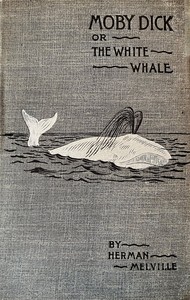
Moby Dick
Herman Melville, 1851
A sea story that keeps stopping to joke, lecture on whales, and stare into the abyss, led by a captain who has turned grief into a single, ruinous purpose.
 BookFeed Ελληνικά
Pages from Moby Dick that stand on their own, chosen for how they read today. The text is in the public domain.
The calm island inside you, and the ocean waiting around it.
Consider all this; and then turn to this green, gentle, and most docile earth; consider them both, the sea and the land; and do you not find a strange analogy to something in yourself? For as this appalling ocean surrounds the verdant land, so in the soul of man there lies one insular Tahiti, full of peace and joy, but encompassed by all the horrors of the half known life. God keep thee! Push not off from that isle, thou canst never return! A flat, purring afternoon sea that you must not trust.
At such times, under an abated sun; afloat all day upon smooth, slow heaving swells; seated in his boat, light as a birch canoe; and so sociably mixing with the soft waves themselves, that like hearth-stone cats they purr against the gunwale; these are the times of dreamy quietude, when beholding the tranquil beauty and brilliancy of the ocean’s skin, one forgets the tiger heart that pants beneath it; and would not willingly remember, that this velvet paw but conceals a remorseless fang. The mood where the whole universe feels like a joke at your expense.
There are certain queer times and occasions in this strange mixed affair we call life when a man takes this whole universe for a vast practical joke, though the wit thereof he but dimly discerns, and more than suspects that the joke is at nobody’s expense but his own. However, nothing dispirits, and nothing seems worth while disputing. He bolts down all events, all creeds, and beliefs, and persuasions, all hard things visible and invisible, never mind how knobby; as an ostrich of potent digestion gobbles down bullets and gun flints. And as for small difficulties and worryings, prospects of sudden disaster, peril of life and limb; all these, and death itself, seem to him only sly, good-natured hits, and jolly punches in the side bestowed by the unseen and unaccountable old joker. A giant's tiny eye and a quiet warning about your own mind.
Is it not curious, that so vast a being as the whale should see the world through so small an eye, and hear the thunder through an ear which is smaller than a hare’s? But if his eyes were broad as the lens of Herschel’s great telescope; and his ears capacious as the porches of cathedrals; would that make him any longer of sight, or sharper of hearing? Not at all.—Why then do you try to “enlarge” your mind? Subtilize it. A restless mind fills with ghostly processions before it ever sets sail.
By reason of these things, then, the whaling voyage was welcome; the great flood-gates of the wonder-world swung open, and in the wild conceits that swayed me to my purpose, two and two there floated into my inmost soul, endless processions of the whale, and, mid most of them all, one grand hooded phantom, like a snow hill in the air. Daydreaming a hundred feet up, one small movement from disaster.
There is no life in thee, now, except that rocking life imparted by a gently rolling ship; by her, borrowed from the sea; by the sea, from the inscrutable tides of God. But while this sleep, this dream is on ye, move your foot or hand an inch; slip your hold at all; and your identity comes back in horror. Over Descartian vortices you hover. And perhaps, at mid-day, in the fairest weather, with one half-throttled shriek you drop through that transparent air into the summer sea, no more to rise for ever. Look at your Saturday meat counter and decide who the savage is.
It is not, perhaps, entirely because the whale is so excessively unctuous that landsmen seem to regard the eating of him with abhorrence; that appears to result, in some way, from the consideration before mentioned: i.e. that a man should eat a newly murdered thing of the sea, and eat it too by its own light. But no doubt the first man that ever murdered an ox was regarded as a murderer; perhaps he was hung; and if he had been put on his trial by oxen, he certainly would have been; and he certainly deserved it if any murderer does. Go to the meat-market of a Saturday night and see the crowds of live bipeds staring up at the long rows of dead quadrupeds. Does not that sight take a tooth out of the cannibal’s jaw? Cannibals? who is not a cannibal? Where a person's faith stops being merely their own business.
Now, as I before hinted, I have no objection to any person’s religion, be it what it may, so long as that person does not kill or insult any other person, because that other person don’t believe it also. But when a man’s religion becomes really frantic; when it is a positive torment to him; and, in fine, makes this earth of ours an uncomfortable inn to lodge in; then I think it high time to take that individual aside and argue the point with him. Why confidences come easier lying down in the dark beside someone.
How it is I know not; but there is no place like a bed for confidential disclosures between friends. Man and wife, they say, there open the very bottom of their souls to each other; and some old couples often lie and chat over old times till nearly morning. Thus, then, in our hearts’ honeymoon, lay I and Queequeg—a cosy, loving pair. Herman Melville, 1851
A sea story that keeps stopping to joke, lecture on whales, and stare into the abyss, led by a captain who has turned grief into a single, ruinous purpose.
Read pages from books like this, one at a time
BookFeed is a feed of real passages from real books. It learns what moves you and finds your next book.
Open BookFeedFree, no sign-up.