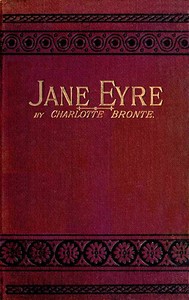
Jane Eyre
Charlotte Brontë, 1847
An orphan with no money, no beauty and a ferocious sense of her own worth takes a job at a strange house. A first-person voice that still feels startlingly direct.
 BookFeed Ελληνικά
Pages from Jane Eyre that stand on their own, chosen for how they read today. The text is in the public domain.
Looking at someone you shouldn't, knowing precisely what it will cost.
No sooner did I see that his attention was riveted on them, and that I might gaze without being observed, than my eyes were drawn involuntarily to his face; I could not keep their lids under control: they would rise, and the irids would fix on him. I looked, and had an acute pleasure in looking,—a precious yet poignant pleasure; pure gold, with a steely point of agony: a pleasure like what the thirst-perishing man might feel who knows the well to which he has crept is poisoned, yet stoops and drinks divine draughts nevertheless. Winning the argument, then tasting what the victory is made of.
Something of vengeance I had tasted for the first time; as aromatic wine it seemed, on swallowing, warm and racy: its after-flavour, metallic and corroding, gave me a sensation as if I had been poisoned. Willingly would I now have gone and asked Mrs. Reed’s pardon; but I knew, partly from experience and partly from instinct, that was the way to make her repulse me with double scorn, thereby re-exciting every turbulent impulse of my nature. The first time you say the true thing to someone who ruled you.
Ere I had finished this reply, my soul began to expand, to exult, with the strangest sense of freedom, of triumph, I ever felt. It seemed as if an invisible bond had burst, and that I had struggled out into unhoped-for liberty. Not without cause was this sentiment: Mrs. Reed looked frightened; her work had slipped from her knee; she was lifting up her hands, rocking herself to and fro, and even twisting her face as if she would cry. A plain man whose confidence makes you forget to judge his face.
I am sure most people would have thought him an ugly man; yet there was so much unconscious pride in his port; so much ease in his demeanour; such a look of complete indifference to his own external appearance; so haughty a reliance on the power of other qualities, intrinsic or adventitious, to atone for the lack of mere personal attractiveness, that, in looking at him, one inevitably shared the indifference, and, even in a blind, imperfect sense, put faith in the confidence. The day a harsh place turns, briefly, into a garden.
April advanced to May: a bright serene May it was; days of blue sky, placid sunshine, and soft western or southern gales filled up its duration. And now vegetation matured with vigour; Lowood shook loose its tresses; it became all green, all flowery; its great elm, ash, and oak skeletons were restored to majestic life; woodland plants sprang up profusely in its recesses; unnumbered varieties of moss filled its hollows, and it made a strange ground-sunshine out of the wealth of its wild primrose plants: I have seen their pale gold gleam in overshadowed spots like scatterings of the sweetest lustre. A child discovers that fury can feel exactly like a war.
What a consternation of soul was mine that dreary afternoon! How all my brain was in tumult, and all my heart in insurrection! Yet in what darkness, what dense ignorance, was the mental battle fought! I could not answer the ceaseless inward question—why I thus suffered; now, at the distance of—I will not say how many years, I see it clearly. Being young, newly on your own, and a little afraid no one is coming.
It is a very strange sensation to inexperienced youth to feel itself quite alone in the world, cut adrift from every connection, uncertain whether the port to which it is bound can be reached, and prevented by many impediments from returning to that it has quitted. The charm of adventure sweetens that sensation, the glow of pride warms it; but then the throb of fear disturbs it; and fear with me became predominant when half-an-hour elapsed and still I was alone. Three odd words for the things we sense before we know them.
Presentiments are strange things! and so are sympathies; and so are signs; and the three combined make one mystery to which humanity has not yet found the key. I never laughed at presentiments in my life, because I have had strange ones of my own. Sympathies, I believe, exist (for instance, between far-distant, long-absent, wholly estranged relatives asserting, notwithstanding their alienation, the unity of the source to which each traces his origin) whose workings baffle mortal comprehension. And signs, for aught we know, may be but the sympathies of Nature with man. Charlotte Brontë, 1847
An orphan with no money, no beauty and a ferocious sense of her own worth takes a job at a strange house. A first-person voice that still feels startlingly direct.
Read pages from books like this, one at a time
BookFeed is a feed of real passages from real books. It learns what moves you and finds your next book.
Open BookFeedFree, no sign-up.