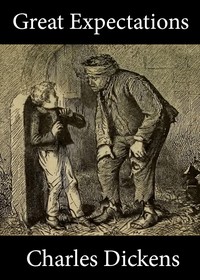
Great Expectations
Charles Dickens, 1861
A blacksmith's orphan is made rich by a stranger, and finds out what money does to love, friendship and memory.
 BookFeed
Pages from Great Expectations that stand on their own, chosen for how they read today. The text is in the public domain.
Cold enough that the sky stops being any comfort at all.
Joe made the fire and swept the hearth, and then we went to the door to listen for the chaise-cart. It was a dry cold night, and the wind blew keenly, and the frost was white and hard. A man would die tonight of lying out on the marshes, I thought. And then I looked at the stars, and considered how awful it would be for a man to turn his face up to them as he froze to death, and see no help or pity in all the glittering multitude. A black river at night, and one warm light that isn't yours.
As the night was fast falling, and as the moon, being past the full, would not rise early, we held a little council; a short one, for clearly our course was to lie by at the first lonely tavern we could find. So, they plied their oars once more, and I looked out for anything like a house. Thus we held on, speaking little, for four or five dull miles. It was very cold, and, a collier coming by us, with her galley-fire smoking and flaring, looked like a comfortable home. The night was as dark by this time as it would be until morning; and what light we had, seemed to come more from the river than the sky, as the oars in their dipping struck at a few reflected stars. A morning so wet it feels like a personal accusation.
It was a rimy morning, and very damp. I had seen the damp lying on the outside of my little window, as if some goblin had been crying there all night, and using the window for a pocket handkerchief. Now, I saw the damp lying on the bare hedges and spare grass, like a coarser sort of spiders’ webs; hanging itself from twig to twig and blade to blade. On every rail and gate, wet lay clammy, and the marsh mist was so thick, that the wooden finger on the post directing people to our village—a direction which they never accepted, for they never came there—was invisible to me until I was quite close under it. Then, as I looked up at it, while it dripped, it seemed to my oppressed conscience like a phantom devoting me to the hulks. The shared pretence of a good time, and the bill that follows.
We spent as much money as we could, and got as little for it as people could make up their minds to give us. We were always more or less miserable, and most of our acquaintance were in the same condition. There was a gay fiction among us that we were constantly enjoying ourselves, and a skeleton truth that we never did. To the best of my belief, our case was in the last aspect a rather common one. A badly made candle that becomes your only company in the dark.
As I had asked for a night-light, the chamberlain had brought me in, before he left me, the good old constitutional rushlight of those virtuous days—an object like the ghost of a walking-cane, which instantly broke its back if it were touched, which nothing could ever be lighted at, and which was placed in solitary confinement at the bottom of a high tin tower, perforated with round holes that made a staringly wide-awake pattern on the walls. When I had got into bed, and lay there footsore, weary, and wretched, I found that I could no more close my own eyes than I could close the eyes of this foolish Argus. And thus, in the gloom and death of the night, we stared at one another. The sounds a strange room makes when you cannot sleep.
What a doleful night! How anxious, how dismal, how long! There was an inhospitable smell in the room, of cold soot and hot dust; and, as I looked up into the corners of the tester over my head, I thought what a number of bluebottle flies from the butchers’, and earwigs from the market, and grubs from the country, must be holding on up there, lying by for next summer. This led me to speculate whether any of them ever tumbled down, and then I fancied that I felt light falls on my face—a disagreeable turn of thought, suggesting other and more objectionable approaches up my back. When I had lain awake a little while, those extraordinary voices with which silence teems began to make themselves audible. The closet whispered, the fireplace sighed, the little washing-stand ticked, and one guitar string played occasionally in the chest of drawers. Everyone in the room knows, and nobody will say it.
There were three ladies in the room and one gentleman. Before I had been standing at the window five minutes, they somehow conveyed to me that they were all toadies and humbugs, but that each of them pretended not to know that the others were toadies and humbugs: because the admission that he or she did know it, would have made him or her out to be a toady and humbug. A face like a rough draft someone gave up on.
Casting my eyes on Mr. Wemmick as we went along, to see what he was like in the light of day, I found him to be a dry man, rather short in stature, with a square wooden face, whose expression seemed to have been imperfectly chipped out with a dull-edged chisel. There were some marks in it that might have been dimples, if the material had been softer and the instrument finer, but which, as it was, were only dints. The chisel had made three or four of these attempts at embellishment over his nose, but had given them up without an effort to smooth them off. A bath given like an assault, with a wedding ring as the weapon.
With that, she pounced upon me, like an eagle on a lamb, and my face was squeezed into wooden bowls in sinks, and my head was put under taps of water-butts, and I was soaped, and kneaded, and towelled, and thumped, and harrowed, and rasped, until I really was quite beside myself. (I may here remark that I suppose myself to be better acquainted than any living authority, with the ridgy effect of a wedding ring, passing unsympathetically over the human countenance.) Charles Dickens, 1861
A blacksmith's orphan is made rich by a stranger, and finds out what money does to love, friendship and memory.
Read pages from books like this, one at a time
BookFeed is a feed of real passages from real books. It learns what moves you and finds your next book.
Open BookFeedFree, no sign-up.