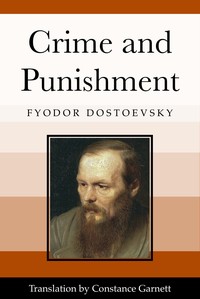
Crime and Punishment
Fyodor Dostoevsky, 1866
A broke student in St. Petersburg tests a theory that some people are above the law, and discovers the cost is not legal but psychological.
 BookFeed
Pages from Crime and Punishment that stand on their own, chosen for how they read today. The text is in the public domain.
What if the punishment you wanted most was remorse, and it never came.
And if only fate would have sent him repentance—burning repentance that would have torn his heart and robbed him of sleep, that repentance, the awful agony of which brings visions of hanging or drowning! Oh, he would have been glad of it! Tears and agonies would at least have been life. But he did not repent of his crime. Why crowds can feel easier than empty roads.
He felt very miserable. If it had been possible to escape to some solitude, he would have thought himself lucky, even if he had to spend his whole life there. But although he had almost always been by himself of late, he had never been able to feel alone. Sometimes he walked out of the town on to the high road, once he had even reached a little wood, but the lonelier the place was, the more he seemed to be aware of an uneasy presence near him. It did not frighten him, but greatly annoyed him, so that he made haste to return to the town, to mingle with the crowd, to enter restaurants and taverns, to walk in busy thoroughfares. There he felt easier and even more solitary. What the mind does when it cannot bear to be inside itself.
Raskolnikov turned to the wall where in the dirty, yellow paper he picked out one clumsy, white flower with brown lines on it and began examining how many petals there were in it, how many scallops in the petals and how many lines on them. He felt his arms and legs as lifeless as though they had been cut off. He did not attempt to move, but stared obstinately at the flower. Cold room, howling wind, and a mind that wants a garden.
There was a cold damp draught from the window, however; without getting up he drew the blanket over him and wrapped himself in it. He was not thinking of anything and did not want to think. But one image rose after another, incoherent scraps of thought without beginning or end passed through his mind. He sank into drowsiness. Perhaps the cold, or the dampness, or the dark, or the wind that howled under the window and tossed the trees roused a sort of persistent craving for the fantastic. He kept dwelling on images of flowers, he fancied a charming flower garden, a bright, warm, almost hot day, a holiday—Trinity day. Why a fever can invent what a novelist cannot.
In a morbid condition of the brain, dreams often have a singular actuality, vividness, and extraordinary semblance of reality. At times monstrous images are created, but the setting and the whole picture are so truth-like and filled with details so delicate, so unexpectedly, but so artistically consistent, that the dreamer, were he an artist like Pushkin or Turgenev even, could never have invented them in the waking state. Such sick dreams always remain long in the memory and make a powerful impression on the overwrought and deranged nervous system. A defence of talking nonsense, as long as it's your own.
I like them to talk nonsense. That’s man’s one privilege over all creation. Through error you come to the truth! I am a man because I err! You never reach any truth without making fourteen mistakes and very likely a hundred and fourteen. And a fine thing, too, in its way; but we can’t even make mistakes on our own account! Talk nonsense, but talk your own nonsense, and I’ll kiss you for it. To go wrong in one’s own way is better than to go right in someone else’s. In the first case you are a man, in the second you’re no better than a bird. Truth won’t escape you, but life can be cramped. The moment an old question stops being a thought and becomes a demand.
So he tortured himself, fretting himself with such questions, and finding a kind of enjoyment in it. And yet all these questions were not new ones suddenly confronting him, they were old familiar aches. It was long since they had first begun to grip and rend his heart. Long, long ago his present anguish had its first beginnings; it had waxed and gathered strength, it had matured and concentrated, until it had taken the form of a fearful, frenzied and fantastic question, which tortured his heart and mind, clamouring insistently for an answer. Now his mother’s letter had burst on him like a thunderclap. It was clear that he must not now suffer passively, worrying himself over unsolved questions, but that he must do something, do it at once, and do it quickly. The reason clever criminals get caught is almost childish.
At first—long before indeed—he had been much occupied with one question; why almost all crimes are so badly concealed and so easily detected, and why almost all criminals leave such obvious traces? He had come gradually to many different and curious conclusions, and in his opinion the chief reason lay not so much in the material impossibility of concealing the crime, as in the criminal himself. Almost every criminal is subject to a failure of will and reasoning power by a childish and phenomenal heedlessness, at the very instant when prudence and caution are most essential. A face so handsome it feels like a mask.
It was a strange face, like a mask; white and red, with bright red lips, with a flaxen beard, and still thick flaxen hair. His eyes were somehow too blue and their expression somehow too heavy and fixed. There was something awfully unpleasant in that handsome face, which looked so wonderfully young for his age. Svidrigaïlov was smartly dressed in light summer clothes and was particularly dainty in his linen. He wore a huge ring with a precious stone in it. Fyodor Dostoevsky, 1866
A broke student in St. Petersburg tests a theory that some people are above the law, and discovers the cost is not legal but psychological.
Read pages from books like this, one at a time
BookFeed is a feed of real passages from real books. It learns what moves you and finds your next book.
Open BookFeedFree, no sign-up.