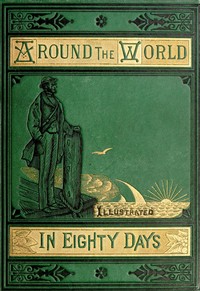
Around the World in Eighty Days
Jules Verne, 1872
A rich Londoner bets his fortune that he can circle the globe in eighty days, and spends every hour of them proving a timetable can beat the world.
 BookFeed
Pages from Around the World in Eighty Days that stand on their own, chosen for how they read today. The text is in the public domain.
What a storm looks like to the one person aboard not frightened of it.
Phileas Fogg, with body erect and legs wide apart, standing like a sailor, gazed without staggering at the swelling waters. The young woman, who was seated aft, was profoundly affected as she looked out upon the ocean, darkening now with the twilight, on which she had ventured in so frail a vessel. Above her head rustled the white sails, which seemed like great white wings. The boat, carried forward by the wind, seemed to be flying in the air. A sailboat crossing a desert, with wolves running behind it.
While each of the party was absorbed in reflections so different, the sledge flew past over the vast carpet of snow. The creeks it passed over were not perceived. Fields and streams disappeared under the uniform whiteness. The plain was absolutely deserted. Between the Union Pacific road and the branch which unites Kearney with Saint Joseph it formed a great uninhabited island. Neither village, station, nor fort appeared. From time to time they sped by some phantom-like tree, whose white skeleton twisted and rattled in the wind. Sometimes flocks of wild birds rose, or bands of gaunt, famished, ferocious prairie-wolves ran howling after the sledge. Passepartout, revolver in hand, held himself ready to fire on those which came too near. Eighty days of gas, and one bill nobody thought to stop.
First of all, the worthy fellow had gone up to his room, and had extinguished the gas burner, which had been burning for eighty days. He had found in the letterbox a bill from the gas company, and he thought it more than time to put a stop to this expense, which he had been doomed to bear. The cost of never wasting a single step.
He was so exact that he was never in a hurry, was always ready, and was economical alike of his steps and his motions. He never took one step too many, and always went to his destination by the shortest cut; he made no superfluous gestures, and was never seen to be moved or agitated. He was the most deliberate person in the world, yet always reached his destination at the exact moment. When a nation turns one man's punctuality into a traded commodity.
Everybody knows that England is the world of betting men, who are of a higher class than mere gamblers; to bet is in the English temperament. Not only the members of the Reform, but the general public, made heavy wagers for or against Phileas Fogg, who was set down in the betting books as if he were a racehorse. Bonds were issued, and made their appearance on ’Change; “Phileas Fogg bonds” were offered at par or at a premium, and a great business was done in them. But five days after the article in the bulletin of the Geographical Society appeared, the demand began to subside: “Phileas Fogg” declined. They were offered by packages, at first of five, then of ten, until at last nobody would take less than twenty, fifty, a hundred! A continent glimpsed at speed, through glass, between stations.
Passepartout, on waking and looking out, could not realise that he was actually crossing India in a railway train. The locomotive, guided by an English engineer and fed with English coal, threw out its smoke upon cotton, coffee, nutmeg, clove, and pepper plantations, while the steam curled in spirals around groups of palm-trees, in the midst of which were seen picturesque bungalows, viharis (sort of abandoned monasteries), and marvellous temples enriched by the exhaustless ornamentation of Indian architecture. Then they came upon vast tracts extending to the horizon, with jungles inhabited by snakes and tigers, which fled at the noise of the train; succeeded by forests penetrated by the railway, and still haunted by elephants which, with pensive eyes, gazed at the train as it passed. The travellers crossed, beyond Milligaum, the fatal country so often stained with blood by the sectaries of the goddess Kali. The one object on board that refuses to be argued with.
Passepartout remained on deck as long as the tempest lasted, being unable to remain quiet below, and taking it into his head to aid the progress of the ship by lending a hand with the crew. He overwhelmed the captain, officers, and sailors, who could not help laughing at his impatience, with all sorts of questions. He wanted to know exactly how long the storm was going to last; whereupon he was referred to the barometer, which seemed to have no intention of rising. Passepartout shook it, but with no perceptible effect; for neither shaking nor maledictions could prevail upon it to change its mind. Twelve thousand animals that will not move for your schedule.
This happened, indeed, to the train in which Mr. Fogg was travelling. About twelve o’clock a troop of ten or twelve thousand head of buffalo encumbered the track. The locomotive, slackening its speed, tried to clear the way with its cowcatcher; but the mass of animals was too great. The buffaloes marched along with a tranquil gait, uttering now and then deafening bellowings. There was no use of interrupting them, for, having taken a particular direction, nothing can moderate and change their course; it is a torrent of living flesh which no dam could contain. What a former acrobat has that the other passengers don't.
Mr. Fogg had not time to stop the brave fellow, who, opening a door unperceived by the Indians, succeeded in slipping under the car; and while the struggle continued and the balls whizzed across each other over his head, he made use of his old acrobatic experience, and with amazing agility worked his way under the cars, holding on to the chains, aiding himself by the brakes and edges of the sashes, creeping from one car to another with marvellous skill, and thus gaining the forward end of the train. Jules Verne, 1872
A rich Londoner bets his fortune that he can circle the globe in eighty days, and spends every hour of them proving a timetable can beat the world.
Read pages from books like this, one at a time
BookFeed is a feed of real passages from real books. It learns what moves you and finds your next book.
Open BookFeedFree, no sign-up.