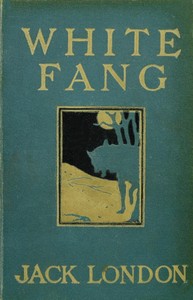
White Fang
Jack London, 1906
 BookFeed English
Σελίδες από το «White Fang» που στέκονται μόνες τους, διαλεγμένες για το πώς διαβάζονται σήμερα. Το κείμενο ανήκει στο κοινό κτήμα.
As the days went by, the evolution of like into love was accelerated. White Fang himself began to grow aware of it, though in his consciousness he knew not what love was. It manifested itself to him as a void in his being—a hungry, aching, yearning void that clamoured to be filled. It was a pain and an unrest; and it received easement only by the touch of the new god’s presence. At such times love was joy to him, a wild, keen-thrilling satisfaction. But when away from his god, the pain and the unrest returned; the void in him sprang up and pressed against him with its emptiness, and the hunger gnawed and gnawed unceasingly. Had the cub thought in man-fashion, he might have epitomised life as a voracious appetite and the world as a place wherein ranged a multitude of appetites, pursuing and being pursued, hunting and being hunted, eating and being eaten, all in blindness and confusion, with violence and disorder, a chaos of gluttony and slaughter, ruled over by chance, merciless, planless, endless. He belonged to them as all dogs belonged to them. His actions were theirs to command. His body was theirs to maul, to stamp upon, to tolerate. Such was the lesson that was quickly borne in upon him. It came hard, going as it did, counter to much that was strong and dominant in his own nature; and, while he disliked it in the learning of it, unknown to himself he was learning to like it. It was a placing of his destiny in another’s hands, a shifting of the responsibilities of existence. This in itself was compensation, for it is always easier to lean upon another than to stand alone. But nobody else ever romped with White Fang. He did not permit it. He stood on his dignity, and when they attempted it, his warning snarl and bristling mane were anything but playful. That he allowed the master these liberties was no reason that he should be a common dog, loving here and loving there, everybody’s property for a romp and good time. He loved with single heart and refused to cheapen himself or his love. And then the cub saw his mother, the she-wolf, the fearless one, crouching down till her belly touched the ground, whimpering, wagging her tail, making peace signs. The cub could not understand. He was appalled. The awe of man rushed over him again. His instinct had been true. His mother verified it. She, too, rendered submission to the man-animals. The possession of a god implies service. White Fang’s was a service of duty and awe, but not of love. He did not know what love was. He had no experience of love. Kiche was a remote memory. Besides, not only had he abandoned the Wild and his kind when he gave himself up to man, but the terms of the covenant were such that if ever he met Kiche again he would not desert his god to go with her. His allegiance to man seemed somehow a law of his being greater than the love of liberty, of kind and kin. But that was not all. What of his joy, the great love in him, ever surging and struggling to express itself, succeeded in finding a new mode of expression. He suddenly thrust his head forward and nudged his way in between the master’s arm and body. And here, confined, hidden from view all except his ears, no longer growling, he continued to nudge and snuggle. Once, lying awake, he heard a strange sound in the white wall. He did not know that it was a wolverine, standing outside, all a-trembling with its own daring, and cautiously scenting out the contents of the cave. The cub knew only that the sniff was strange, a something unclassified, therefore unknown and terrible—for the unknown was one of the chief elements that went into the making of fear. But the cub was learning. His misty little mind had already made an unconscious classification. There were live things and things not alive. Also, he must watch out for the live things. The things not alive remained always in one place, but the live things moved about, and there was no telling what they might do. The thing to expect of them was the unexpected, and for this he must be prepared. Jack London, 1906
Διάβασε σελίδες από βιβλία σαν αυτό, μία τη φορά
Το BookFeed είναι μια ροή με αποσπάσματα από βιβλία. Μαθαίνει τι σου αρέσει και σε βοηθά να βρεις το επόμενο βιβλίο σου.
Άνοιξε το BookFeedΔωρεάν, χωρίς εγγραφή.