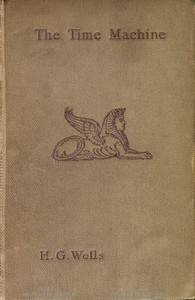
Η μηχανή του χρόνου
H. G. Wells, 1895
Μια ιστορία που ξεκινά σε ένα δείπνο: ένας ταξιδιώτης του χρόνου επιστρέφει από το μακρινό μέλλον με μια προειδοποίηση για τις τάξεις, την άνεση και την πορεία του ανθρώπινου είδους.
 BookFeed English
Σελίδες από το «Η μηχανή του χρόνου» που στέκονται μόνες τους, διαλεγμένες για το πώς διαβάζονται σήμερα. Το κείμενο ανήκει στο κοινό κτήμα.
Κυνηγά το τέλος του κόσμου με άλματα χιλίων ετών.
“So I travelled, stopping ever and again, in great strides of a thousand years or more, drawn on by the mystery of the earth’s fate, watching with a strange fascination the sun grow larger and duller in the westward sky, and the life of the old earth ebb away. At last, more than thirty million years hence, the huge red-hot dome of the sun had come to obscure nearly a tenth part of the darkling heavens. Then I stopped once more, for the crawling multitude of crabs had disappeared, and the red beach, save for its livid green liverworts and lichens, seemed lifeless. And now it was flecked with white. A bitter cold assailed me. Rare white flakes ever and again came eddying down. To the north-eastward, the glare of snow lay under the starlight of the sable sky, and I could see an undulating crest of hillocks pinkish white. Τι παθαίνουν οι άνθρωποι όταν δεν χρειάζεται πια να προσπαθούν.
“It seemed to me that I had happened upon humanity upon the wane. The ruddy sunset set me thinking of the sunset of mankind. For the first time I began to realise an odd consequence of the social effort in which we are at present engaged. And yet, come to think, it is a logical consequence enough. Strength is the outcome of need; security sets a premium on feebleness. The work of ameliorating the conditions of life—the true civilising process that makes life more and more secure—had gone steadily on to a climax. One triumph of a united humanity over Nature had followed another. Things that are now mere dreams had become projects deliberately put in hand and carried forward. And the harvest was what I saw! Πώς είναι όταν οι μέρες αρχίζουν να περνούν σε δευτερόλεπτα.
“I am afraid I cannot convey the peculiar sensations of time travelling. They are excessively unpleasant. There is a feeling exactly like that one has upon a switchback—of a helpless headlong motion! I felt the same horrible anticipation, too, of an imminent smash. As I put on pace, night followed day like the flapping of a black wing. The dim suggestion of the laboratory seemed presently to fall away from me, and I saw the sun hopping swiftly across the sky, leaping it every minute, and every minute marking a day. I supposed the laboratory had been destroyed and I had come into the open air. I had a dim impression of scaffolding, but I was already going too fast to be conscious of any moving things. The slowest snail that ever crawled dashed by too fast for me. Πώς μια ζωή γεμάτη άνεση μπορεί να αμβλύνει το μυαλό.
“It is a law of nature we overlook, that intellectual versatility is the compensation for change, danger, and trouble. An animal perfectly in harmony with its environment is a perfect mechanism. Nature never appeals to intelligence until habit and instinct are useless. There is no intelligence where there is no change and no need of change. Only those animals partake of intelligence that have to meet a huge variety of needs and dangers. Το παράξενο τίμημα του να κάνεις τα εντυπωσιακά να φαίνονται εύκολα.
I think that at that time none of us quite believed in the Time Machine. The fact is, the Time Traveller was one of those men who are too clever to be believed: you never felt that you saw all round him; you always suspected some subtle reserve, some ingenuity in ambush, behind his lucid frankness. Had Filby shown the model and explained the matter in the Time Traveller’s words, we should have shown him far less scepticism. For we should have perceived his motives: a pork-butcher could understand Filby. But the Time Traveller had more than a touch of whim among his elements, and we distrusted him. Things that would have made the fame of a less clever man seemed tricks in his hands. It is a mistake to do things too easily. Φτάνει αιώνες μακριά από το σπίτι και αναρωτιέται ποιος τον περιμένει.
“I looked up again at the crouching white shape, and the full temerity of my voyage came suddenly upon me. What might appear when that hazy curtain was altogether withdrawn? What might not have happened to men? What if cruelty had grown into a common passion? What if in this interval the race had lost its manliness, and had developed into something inhuman, unsympathetic, and overwhelmingly powerful? I might seem some old-world savage animal, only the more dreadful and disgusting for our common likeness—a foul creature to be incontinently slain. Όταν νομίζεις πως τα εξήγησες όλα, ίσως βιάζεσαι.
“As I stood there in the gathering dark I thought that in this simple explanation I had mastered the problem of the world—mastered the whole secret of these delicious people. Possibly the checks they had devised for the increase of population had succeeded too well, and their numbers had rather diminished than kept stationary. That would account for the abandoned ruins. Very simple was my explanation, and plausible enough—as most wrong theories are! Κι αν η υπομονή είναι ο μόνος τρόπος να καταλάβεις έναν άγνωστο κόσμο;
“I got up after a time, and began walking aimlessly through the bushes towards the hill again. ‘Patience,’ said I to myself. ‘If you want your machine again you must leave that sphinx alone. If they mean to take your machine away, it’s little good your wrecking their bronze panels, and if they don’t, you will get it back as soon as you can ask for it. To sit among all those unknown things before a puzzle like that is hopeless. That way lies monomania. Face this world. Learn its ways, watch it, be careful of too hasty guesses at its meaning. In the end you will find clues to it all.’ Ένας μετεωρολογικός χάρτης δείχνει πως το χθες είναι ένας τόπος.
“Scientific people,” proceeded the Time Traveller, after the pause required for the proper assimilation of this, “know very well that Time is only a kind of Space. Here is a popular scientific diagram, a weather record. This line I trace with my finger shows the movement of the barometer. Yesterday it was so high, yesterday night it fell, then this morning it rose again, and so gently upward to here. Surely the mercury did not trace this line in any of the dimensions of Space generally recognised? But certainly it traced such a line, and that line, therefore, we must conclude, was along the Time-Dimension.” H. G. Wells, 1895
Μια ιστορία που ξεκινά σε ένα δείπνο: ένας ταξιδιώτης του χρόνου επιστρέφει από το μακρινό μέλλον με μια προειδοποίηση για τις τάξεις, την άνεση και την πορεία του ανθρώπινου είδους.
Διάβασε σελίδες από βιβλία σαν αυτό, μία τη φορά
Το BookFeed είναι μια ροή με αποσπάσματα από βιβλία. Μαθαίνει τι σου αρέσει και σε βοηθά να βρεις το επόμενο βιβλίο σου.
Άνοιξε το BookFeedΔωρεάν, χωρίς εγγραφή.