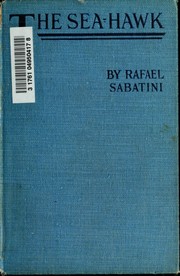
The Sea Hawk
Rafael Sabatini, 1915
Προδομένος και αλυσοδεμένος στον πάγκο των κωπηλατών, γίνεται κουρσάρος της Μπαρμπαριάς και ζητά εκδίκηση. Κι όμως, η ιστορία συνεχίζει να ρωτά πόση αξία έχει ένας άνθρωπος όταν τα έχει χάσει όλα.
 BookFeed English
Σελίδες από το «The Sea Hawk» που στέκονται μόνες τους, διαλεγμένες για το πώς διαβάζονται σήμερα. Το κείμενο ανήκει στο κοινό κτήμα.
Ο άντρας που κοιμάται στην πόρτα σου χωρίς να εξηγεί το γιατί.
It would be towards midnight when unable longer to bear the suspense of it, she rose and softly made her way to the entrance. Very quietly she lifted the curtain, and in the act of stepping forth almost stumbled over a body that lay across the threshold. She drew back with a startled gasp; then stooped to look, and by the faint rays of the lanterns on mainmast and poop rail she recognized Sir Oliver, and saw that he slept. She never heeded the two Nubians immovable as statues who kept guard. She continued to bend over him, and then gradually and very softly sank down on her knees beside him. There were tears in her eyes—tears wrung from her by a tender emotion of wonder and gratitude at so much fidelity. She did not know that he had slept thus last night. Τι απομένει από έναν άνθρωπο όταν τον έχουν κάνει μόνο μπράτσα.
Thus day in day out, now broiled and blistered by the pitiless southern sun, now chilled by the night dews whilst he took his cramped and unrefreshing rest, indescribably filthy and dishevelled, his hair and beard matted with endless sweat, unwashed save by the rains which in that season were all too rare, choked almost by the stench of his miserable comrades and infested by filthy crawling things begotten of decaying sheepskins and Heaven alone knows what other foulnesses of that floating hell. He was sparingly fed upon weevilled biscuit and vile messes of tallowy rice, and to drink he was given lukewarm water that was often stale, saving that sometimes when the spell of rowing was more than usually protracted the boatswains would thrust lumps of bread sodden in wine into the mouths of the toiling slaves to sustain them. Η μοναξιά του να βλέπεις μια πόλη που αγαπάς να βυθίζεται στο σκοτάδι.
Sakr-el-Bahr himself paced the poop deck of the carack and watched the lights perish one by one in the little town that straggled up the hillside before him. The moon came up and bathed it in a white hard light, throwing sharp inky shadows of rustling date palm and spearlike minaret, and flinging shafts of silver athwart the peaceful bay. Ένας γάμος ως συμφωνία για γη, με το ζευγάρι σε δεύτερη μοίρα.
Oliver-Reis laughed when he had read thus far. The marriage was approved not for itself, it would seem, but because by means of it two stretches of earth were united into one. It was a marriage of two parks, of two estates, of two tracts of arable and forest, and that two human beings were concerned in it was apparently no more than an incidental circumstance. Ακόμα κι όσοι θα σε σκοτώσουν μπαλώνουν τα ρούχα τους στον ήλιο.
The vessel’s vast prow, which ended in a steel ram and was armed with a culverin on either quarter, was crowded with lounging corsairs, who took their ease there until the time to engage should be upon them. They leaned on the high bulwarks or squatted in groups, talking, laughing, some of them tailoring and repairing garments, others burnishing their weapons or their armour, and one swarthy youth there was who thrummed a gimbri and sang a melancholy Shilha love-song to the delight of a score or so of bloodthirsty ruffians squatting about him in a ring of variegated colour. Η ψύχραιμη αποτίμηση ενός ανθρώπου που θεωρεί πως η ζωή του έχει τελειώσει.
For a long hour he lay where he had fallen, believing himself alone; and time and place would no doubt conduce to philosophical reflection upon his condition. I like to think that he found that when all was considered, he had little with which to reproach himself. If he had done evil he had made ample amends. It can scarcely be pretended that he had betrayed those loyal Muslimeen followers of his, or, if it is, at least it must be added that he himself had paid the price of that betrayal. Rosamund was safe, Lionel would meet the justice due to him, and as for himself, being as good as dead already, he was worth little thought. He must have derived some measure of content from the reflection that he was spending his life to the very best advantage. Ruined it had been long since. Η πρώτη φορά που κάποιος τον λέει ανόητο κατά πρόσωπο.
He recoiled. Being a man of position and importance, quick, fearless, and vindictive of temperament—and also, it would seem, extremely fortunate—it had never happened to him in all his life to be so uncompromisingly and frankly judged. She was by no means the first to account him a fool, but she was certainly the first to call him one to his face; and whilst to the general it might have proved her extreme sanity, to him it was no more than the culminating proof of her mental distemper. Τι σημαίνει το νυφικό λευκό όταν μπαίνει ο λάθος άντρας.
She was standing in mid-apartment, dressed by an odd irony all in bridal white, that yet was not as white as was her face. Her eyes looked like two black stains, solemn and haunting as they fastened up on this intruder who would not be refused. Her lips parted, but she had no word for him. She just stared in a horror that routed all his audacity and checked the masterfulness of his advance. Rafael Sabatini, 1915
Προδομένος και αλυσοδεμένος στον πάγκο των κωπηλατών, γίνεται κουρσάρος της Μπαρμπαριάς και ζητά εκδίκηση. Κι όμως, η ιστορία συνεχίζει να ρωτά πόση αξία έχει ένας άνθρωπος όταν τα έχει χάσει όλα.
Διάβασε σελίδες από βιβλία σαν αυτό, μία τη φορά
Το BookFeed είναι μια ροή με αποσπάσματα από βιβλία. Μαθαίνει τι σου αρέσει και σε βοηθά να βρεις το επόμενο βιβλίο σου.
Άνοιξε το BookFeedΔωρεάν, χωρίς εγγραφή.