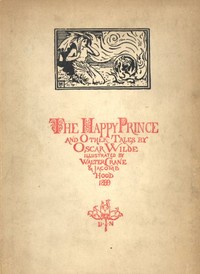
Αποσπάσματα από το «Ο ευτυχισμένος πρίγκιπας και άλλα παραμύθια»
Σελίδες από το «Ο ευτυχισμένος πρίγκιπας και άλλα παραμύθια» που στέκονται μόνες τους, διαλεγμένες για το πώς διαβάζονται σήμερα. Το κείμενο ανήκει στο κοινό κτήμα.
Όσα βλέπεις μόνο όταν υψωθείς πάνω από τη ζωή σου.
“When I was alive and had a human heart,” answered the statue, “I did not know what tears were, for I lived in the Palace of Sans-Souci, where sorrow is not allowed to enter. In the daytime I played with my companions in the garden, and in the evening I led the dance in the Great Hall. Round the garden ran a very lofty wall, but I never cared to ask what lay beyond it, everything about me was so beautiful. My courtiers called me the Happy Prince, and happy indeed I was, if pleasure be happiness. So I lived, and so I died. And now that I am dead they have set me up here so high that I can see all the ugliness and all the misery of my city, and though my heart is made of lead yet I cannot chose but weep.”
— Ο ευτυχισμένος πρίγκιπας και άλλα παραμύθια, Oscar Wilde (1888)
Πώς μοιάζει ένα τριαντάφυλλο όταν το πλάθει σιγά σιγά ένα τραγούδι.
She sang first of the birth of love in the heart of a boy and a girl. And on the top-most spray of the Rose-tree there blossomed a marvellous rose, petal following petal, as song followed song. Pale was it, at first, as the mist that hangs over the river—pale as the feet of the morning, and silver as the wings of the dawn. As the shadow of a rose in a mirror of silver, as the shadow of a rose in a water-pool, so was the rose that blossomed on the topmost spray of the Tree.
— Ο ευτυχισμένος πρίγκιπας και άλλα παραμύθια, Oscar Wilde (1888)
Η άνοιξη φτάνει παντού στον κήπο, εκτός από μια γωνιά.
He saw a most wonderful sight. Through a little hole in the wall the children had crept in, and they were sitting in the branches of the trees. In every tree that he could see there was a little child. And the trees were so glad to have the children back again that they had covered themselves with blossoms, and were waving their arms gently above the children’s heads. The birds were flying about and twittering with delight, and the flowers were looking up through the green grass and laughing. It was a lovely scene, only in one corner it was still winter. It was the farthest corner of the garden, and in it was standing a little boy. He was so small that he could not reach up to the branches of the tree, and he was wandering all round it, crying bitterly.
— Ο ευτυχισμένος πρίγκιπας και άλλα παραμύθια, Oscar Wilde (1888)
Η ετυμηγορία ενός πρακτικού ανθρώπου για κάθε καλλιτέχνη που τον συγκινεί.
“She has form,” he said to himself, as he walked away through the grove—“that cannot be denied to her; but has she got feeling? I am afraid not. In fact, she is like most artists; she is all style, without any sincerity. She would not sacrifice herself for others. She thinks merely of music, and everybody knows that the arts are selfish. Still, it must be admitted that she has some beautiful notes in her voice. What a pity it is that they do not mean anything, or do any practical good.”
— Ο ευτυχισμένος πρίγκιπας και άλλα παραμύθια, Oscar Wilde (1888)
Το να επαναλαμβάνεις ένα λυπηρό πράγμα δεν το κάνει αληθινό.
But the Catherine Wheel shook her head. “Romance is dead, Romance is dead, Romance is dead,” she murmured. She was one of those people who think that, if you say the same thing over and over a great many times, it becomes true in the end.
— Ο ευτυχισμένος πρίγκιπας και άλλα παραμύθια, Oscar Wilde (1888)
Ένα πυροτέχνημα εξηγεί γιατί τα αισθήματα μετράνε πιο πολύ από το να μείνεις στεγνός.
“Common sense, indeed!” said the Rocket indignantly; “you forget that I am very uncommon, and very remarkable. Why, anybody can have common sense, provided that they have no imagination. But I have imagination, for I never think of things as they really are; I always think of them as being quite different. As for keeping myself dry, there is evidently no one here who can at all appreciate an emotional nature. Fortunately for myself, I don’t care. The only thing that sustains one through life is the consciousness of the immense inferiority of everybody else, and this is a feeling that I have always cultivated. But none of you have any hearts. Here you are laughing and making merry just as if the Prince and Princess had not just been married.”
— Ο ευτυχισμένος πρίγκιπας και άλλα παραμύθια, Oscar Wilde (1888)
Κανείς δεν λέει στον βασιλιά πως η μουσική του είναι κακή, κι εκείνος δεν το μαθαίνει ποτέ.
After the banquet there was to be a Ball. The bride and bridegroom were to dance the Rose-dance together, and the King had promised to play the flute. He played very badly, but no one had ever dared to tell him so, because he was the King. Indeed, he knew only two airs, and was never quite certain which one he was playing; but it made no matter, for, whatever he did, everybody cried out, “Charming! charming!”
— Ο ευτυχισμένος πρίγκιπας και άλλα παραμύθια, Oscar Wilde (1888)
Ένας κάτοικος της λιμνούλας έχει σταθερή γνώμη για το πώς πρέπει να λέγονται οι ιστορίες.
“Then you are quite behind the age,” said the Water-rat. “Every good story-teller nowadays starts with the end, and then goes on to the beginning, and concludes with the middle. That is the new method. I heard all about it the other day from a critic who was walking round the pond with a young man. He spoke of the matter at great length, and I am sure he must have been right, for he had blue spectacles and a bald head, and whenever the young man made any remark, he always answered ‘Pooh!’ But pray go on with your story. I like the Miller immensely. I have all kinds of beautiful sentiments myself, so there is a great sympathy between us.”
— Ο ευτυχισμένος πρίγκιπας και άλλα παραμύθια, Oscar Wilde (1888)
Πώς μια πόλη τιμά ένα θαύμα: γράφει γι’ αυτό και δεν καταλαβαίνει τίποτα.
When day broke he flew down to the river and had a bath. “What a remarkable phenomenon,” said the Professor of Ornithology as he was passing over the bridge. “A swallow in winter!” And he wrote a long letter about it to the local newspaper. Every one quoted it, it was full of so many words that they could not understand.
— Ο ευτυχισμένος πρίγκιπας και άλλα παραμύθια, Oscar Wilde (1888)
Πέντε μικρά παραμύθια όπου ένα άγαλμα, ένα αηδόνι, ένας γίγαντας κι ένα καυχησιάρικο πυροτέχνημα μιλούν για την τρυφερότητα και τη ματαιοδοξία με κοφτερό χιούμορ, σε λιγότερο χρόνο απ’ όσο διαρκεί μια διαδρομή με το μετρό.
Διάβασε σελίδες από βιβλία σαν αυτό, μία τη φορά
Το BookFeed είναι μια ροή με αποσπάσματα από βιβλία. Μαθαίνει τι σου αρέσει και σε βοηθά να βρεις το επόμενο βιβλίο σου.