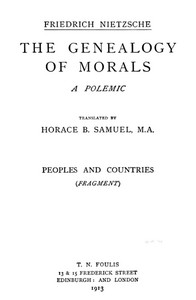
Η γενεαλογία της ηθικής
Friedrich Nietzsche, 1887
Το πιο οξύ βιβλίο του Νίτσε αναρωτιέται από πού προήλθαν οι ιδέες μας για το καλό, την ενοχή και το καθήκον, και βρίσκει από κάτω χρέη, αίμα και αυτοβασανισμό.
 BookFeed English
Σελίδες από το «Η γενεαλογία της ηθικής» που στέκονται μόνες τους, διαλεγμένες για το πώς διαβάζονται σήμερα. Το κείμενο ανήκει στο κοινό κτήμα.
Η καλοσύνη του αρνιού μπορεί να γίνει το δείπνο κάποιου άλλου.
It is not surprising that the lambs should bear a grudge against the great birds of prey, but that is no reason for blaming the great birds of prey for taking the little lambs. And when the lambs say among themselves, “These birds of prey are evil, and he who is as far removed from being a bird of prey, who is rather its opposite, a lamb—is he not good?” then there is nothing to cavil at in the setting up of this ideal, though it may also be that the birds of prey will regard it a little sneeringly, and perchance say to themselves, “We bear no grudge against them, these good lambs, we even like them: nothing is tastier than a tender lamb.” Όταν δεν απομένει εξωτερικός εχθρός, η σκληρότητα στρέφεται προς τα μέσα.
Enmity, cruelty, the delight in persecution, in surprises, change, destruction—the turning all these instincts against their own possessors: this is the origin of the “bad conscience.” It was man, who, lacking external enemies and obstacles, and imprisoned as he was in the oppressive narrowness and monotony of custom, in his own impatience lacerated, persecuted, gnawed, frightened, and ill-treated himself; it was this animal in the hands of the tamer, which beat itself against the bars of its cage; it was this being who, pining and yearning for that desert home of which it had been deprived, was compelled to create out of its own self, an adventure, a torture-chamber, a hazardous and perilous desert—it was this fool, this homesick and desperate prisoner—who invented the “bad conscience.” Κάποιες φωνές στα βιβλία πλησιάζουν τόσο, που αλλάζουν την ανάσα σου.
That spirit yonder nearly always speaks hoarse: has he, perchance, thought himself hoarse? It may be so—ask the physiologists—but he who thinks in words, thinks as a speaker and not as a thinker (it shows that he does not think of objects or think objectively, but only of his relations with objects—that, in point of fact, he only thinks of himself and his audience). This third one speaks aggressively, he comes too near our body, his breath blows on us—we shut our mouth involuntarily, although he speaks to us through a book: the tone of his style supplies the reason—he has no time, he has small faith in himself, he finds expression now or never. But a spirit who is sure of himself speaks softly; he seeks secrecy, he lets himself be awaited. Το κόστος του να ζεις σε ένα περιβάλλον για το οποίο δεν είσαι φτιαγμένος.
Just like the plight of the water-animals, when they were compelled either to become land-animals or to perish, so was the plight of these half-animals, perfectly adapted as they were to the savage life of war, prowling, and adventure—suddenly all their instincts were rendered worthless and “switched off.” Henceforward they had to walk on their feet—“carry themselves,” whereas heretofore they had been carried by the water: a terrible heaviness oppressed them. They found themselves clumsy in obeying the simplest directions, confronted with this new and unknown world they had no longer their old guides—the regulative instincts that had led them unconsciously to safety—they were reduced, were those unhappy creatures, to thinking, inferring, calculating, putting together causes and results, reduced to that poorest and most erratic organ of theirs, their “consciousness.” Τα μεγάλα πράγματα μπορούν να χαθούν από τις δικές τους αντιφάσεις.
All great things go to ruin by reason of themselves, by reason of an act of self-dissolution: so wills the law of life, the law of necessary “self-mastery” even in the essence of life—ever is the lawgiver finally exposed to the cry, “patere legem quam ipse tulisti”; in thus wise did Christianity go to ruin as a dogma, through its own morality; in thus wise must Christianity go again to ruin today as a morality—we are standing on the threshold of this event. After Christian truthfulness has drawn one conclusion after the other, it finally draws its strongest conclusion, its conclusion against itself; this, however, happens, when it puts the question, “what is the meaning of every will for truth?” Ένα μυαλό γαλήνιο κι ένα που κινείται στο σκοτάδι.
While the aristocratic man lived in confidence and openness with himself (γενναῐος, “noble-born,” emphasises the nuance “sincere,” and perhaps also “naive”), the resentful man, on the other hand, is neither sincere nor naive, nor honest and candid with himself. His soul squints; his mind loves hidden crannies, tortuous paths and back-doors, everything secret appeals to him as his world, his safety, his balm; he is past master in silence, in not forgetting, in waiting, in provisional self-depreciation and self-abasement. Αυτό που φοβάται ο στοχαστής δεν είναι η αντίφαση, αλλά το νοικοκυριό.
Every animal, including la bête philosophe, strives instinctively after an optimum of favourable conditions, under which he can let his whole strength have play, and achieves his maximum consciousness of power; with equal instinctiveness, and with a fine perceptive flair which is superior to any reason, every animal shudders mortally at every kind of disturbance and hindrance which obstructs or could obstruct his way to that optimum (it is not his way to happiness of which I am talking, but his way to power, to action, the most powerful action, and in point of fact in many cases his way to unhappiness). Similarly, the philosopher shudders mortally at marriage, together with all that could persuade him to it—marriage as a fatal hindrance on the way to the optimum. Up to the present what great philosophers have been married? Τι σημαίνει να είσαι αρκετά δυνατός ώστε να πάψεις να κρατάς λογαριασμό;
The creditor has always grown more humane proportionately as he has grown more rich; finally the amount of injury he can endure without really suffering becomes the criterion of his wealth. It is possible to conceive of a society blessed with so great a consciousness of its own power as to indulge in the most aristocratic luxury of letting its wrongdoers go scot-free.—“What do my parasites matter to me?” might society say. “Let them live and flourish! I am strong enough for it.”—The justice which began with the maxim, “Everything can be paid off, everything must be paid off,” ends with connivance at the escape of those who cannot pay to escape—it ends, like every good thing on earth, by destroying itself.—The self-destruction of Justice! we know the pretty name it calls itself—Grace! it remains, as is obvious, the privilege of the strongest, better still, their super-law. Τι μπορεί να κρύβει το άδειο βλέμμα ενός ιστορικού.
Or, perchance, does the whole of modern history show in its demeanour greater confidence in life, greater confidence in its ideals? Its loftiest pretension is now to be a mirror; it repudiates all teleology; it will have no more “proving”; it disdains to play the judge, and thereby shows its good taste—it asserts as little as it denies, it fixes, it “describes.” All this is to a high degree ascetic, but at the same time it is to a much greater degree nihilistic; make no mistake about this! You see in the historian a gloomy, hard, but determined gaze—an eye that looks out as an isolated North Pole explorer looks out (perhaps so as not to look within, so as not to look back?)—there is snow—here is life silenced, the last crows which caw here are called “whither?” Friedrich Nietzsche, 1887
Το πιο οξύ βιβλίο του Νίτσε αναρωτιέται από πού προήλθαν οι ιδέες μας για το καλό, την ενοχή και το καθήκον, και βρίσκει από κάτω χρέη, αίμα και αυτοβασανισμό.
Διάβασε σελίδες από βιβλία σαν αυτό, μία τη φορά
Το BookFeed είναι μια ροή με αποσπάσματα από βιβλία. Μαθαίνει τι σου αρέσει και σε βοηθά να βρεις το επόμενο βιβλίο σου.
Άνοιξε το BookFeedΔωρεάν, χωρίς εγγραφή.