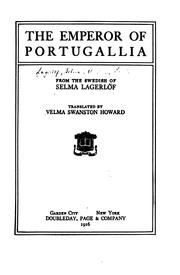
Αποσπάσματα από το «Ο αυτοκράτορας της Πορτουγαλίας»
Σελίδες από το «Ο αυτοκράτορας της Πορτουγαλίας» που στέκονται μόνες τους, διαλεγμένες για το πώς διαβάζονται σήμερα. Το κείμενο ανήκει στο κοινό κτήμα.
Το βράδυ πριν φύγει το παιδί του, ένας πατέρας νιώθει την απώλεια.
Jan moved quietly away from the door, where he had been standing a moment, listening, and sat down on the step. He never thought for an instant that Glory Goldie would remain at home. Indeed he knew better than did anyone else that she must go away. All the same it was to him as if the soft little bundle had again been laid in his arms. His heart had been set going once more. Now it was beating away in his breast as if trying to make up for lost time. With that he felt that his armour of defence was gone.
— Ο αυτοκράτορας της Πορτουγαλίας, Selma Lagerlöf (1914)
Η στιγμή που ένας άντρας καταλαβαίνει τι αξίζει το χειροκρότημα του πλήθους.
This was followed by loud laughs from the crowd, Jan was so dumbfounded that all he could do was to stand still and look at the people. He glanced from one to another, unable to get over his amazement. Dear, dear! Was there no one among all those who had honoured and applauded him who would help him now, in his hour of need? The people stood there, unmoved. He saw then that he meant nothing to them and that they would not lift a finger for him. He became so frightened that all his imperial greatness fell from him, and he was like a little child that is ready to cry because its playthings have been taken away.
— Ο αυτοκράτορας της Πορτουγαλίας, Selma Lagerlöf (1914)
Ένας πατέρας θέλει να ζητήσει κάτι, αλλά δεν βρίσκει τρόπο.
During these visits the father and son immediately they had finished their coffee always went fishing. The old man usually kept very still on these occasions, so as not to scare the fish away, but this year was the exception. He spoke to the son time and again. His words came with difficulty, as always, still there seemed to be more life in him now than ordinarily. Evidently there was something special he wanted to say, or rather something he wished to draw from his son. He was like one who stands outside an empty house shouting and calling, in the hope that somebody will come and open the door to him.
— Ο αυτοκράτορας της Πορτουγαλίας, Selma Lagerlöf (1914)
Η καταστροφή που δεν μπορείς να ξεφύγεις, να αντικρούσεις ή να αποκρούσεις.
He put down his pipe, though it was only half-smoked, but remained quietly seated in the one spot. For what else could he do? This was not something which he could ward off—something he could run away from. One could not take up arms and defend one’s self against it, nor find safety by creeping into cellars or caves. Even if one had the power to empty all the oceans and lakes, their waters would not suffice to quench the fires of the firmament. If one could uproot the mountains and prop them, beam-like, against the sky, they could not hold up this heavy dome if it was meant that it should sink.
— Ο αυτοκράτορας της Πορτουγαλίας, Selma Lagerlöf (1914)
Κεριά σε κάθε παράθυρο, για όποιον περνά στον δρόμο.
The torches that had lighted the Ashdales folk through the woods were burned out when they came to the highroad; but here they went on, guided by the lights from peasant huts. When one house was out of sight, they glimpsed another in the distance, and every house along the road had candles burning at all the windows, to guide the poor wanderers on their way to church.
— Ο αυτοκράτορας της Πορτουγαλίας, Selma Lagerlöf (1914)
Πώς θα μιλούσε ένα νεαρό δέντρο αν κανείς δεν ήθελε να το κόψει;
The air was quite still, therefore it could hardly have been the wind that had set all these little musical instruments into motion. It was almost as if the spruces played for very joy at being so young and fresh; at being let stand in peace by the abandoned roadside, with the promise of many years of life ahead of them before any human being would come and cut them down.
— Ο αυτοκράτορας της Πορτουγαλίας, Selma Lagerlöf (1914)
Ένα παιδί αντικρίζει για πρώτη φορά πόσο μεγάλος είναι ο κόσμος.
At first she sang. But presently she hushed her singing and thought only of gazing out over the wide, open world before her. Suddenly she flung out her arms as if wanting to take it all into her embrace—all this wealth and power and bigness from which she had been shut out until that day.
— Ο αυτοκράτορας της Πορτουγαλίας, Selma Lagerlöf (1914)
Τα γέρικα δέντρα μοιάζουν να παρακολουθούν τους περαστικούς.
The spruce trees up there were old and gnarled, and their branches were dotted with clumps of snow. As seen in the glow of the torch light, one could not but think that some of the trees were really trolls, with gleaming eyes beneath snow hats, and long sharp claws protruding from thick snow mittens.
— Ο αυτοκράτορας της Πορτουγαλίας, Selma Lagerlöf (1914)
Σε κάθε χωριό υπάρχει ένας μάστορας που φοβάσαι να εμπιστευτείς.
The worst of it was that if Agrippa once got his hands on a clock it would never run as well as before, and afterward one had to let him tinker it at least once a year, or it would stop going altogether. The old man tried to do honest and conscientious work, but just the same he ruined all the clocks he touched.
— Ο αυτοκράτορας της Πορτουγαλίας, Selma Lagerlöf (1914)
Ένας φτωχός ακτήμονας λέει στους συγχωριανούς του πως η κόρη του έγινε αυτοκράτειρα και σχεδόν το πιστεύει κι ο ίδιος. Ένα μυθιστόρημα για την αξιοπρέπεια που επινοεί η αγάπη όταν δεν αντέχει την αλήθεια.
Διάβασε σελίδες από βιβλία σαν αυτό, μία τη φορά
Το BookFeed είναι μια ροή με αποσπάσματα από βιβλία. Μαθαίνει τι σου αρέσει και σε βοηθά να βρεις το επόμενο βιβλίο σου.