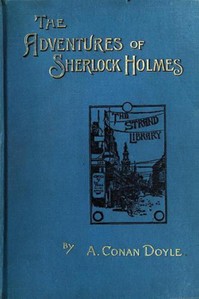
The Adventures of Sherlock Holmes
Arthur Conan Doyle, 1892
 BookFeed English
Σελίδες από το «The Adventures of Sherlock Holmes» που στέκονται μόνες τους, διαλεγμένες για το πώς διαβάζονται σήμερα. Το κείμενο ανήκει στο κοινό κτήμα.
When the commissionaire had gone, Holmes took up the stone and held it against the light. “It’s a bonny thing,” said he. “Just see how it glints and sparkles. Of course it is a nucleus and focus of crime. Every good stone is. They are the devil’s pet baits. In the larger and older jewels every facet may stand for a bloody deed. This stone is not yet twenty years old. It was found in the banks of the Amoy River in southern China and is remarkable in having every characteristic of the carbuncle, save that it is blue in shade instead of ruby red. In spite of its youth, it has already a sinister history. There have been two murders, a vitriol-throwing, a suicide, and several robberies brought about for the sake of this forty-grain weight of crystallised charcoal. “My dear fellow, I know you well. I know the military neatness which characterises you. You shave every morning, and in this season you shave by the sunlight; but since your shaving is less and less complete as we get farther back on the left side, until it becomes positively slovenly as we get round the angle of the jaw, it is surely very clear that that side is less illuminated than the other. I could not imagine a man of your habits looking at himself in an equal light and being satisfied with such a result. I only quote this as a trivial example of observation and inference. Therein lies my métier, and it is just possible that it may be of some service in the investigation which lies before us. Sherlock Holmes was transformed when he was hot upon such a scent as this. Men who had only known the quiet thinker and logician of Baker Street would have failed to recognise him. His face flushed and darkened. His brows were drawn into two hard black lines, while his eyes shone out from beneath them with a steely glitter. His face was bent downward, his shoulders bowed, his lips compressed, and the veins stood out like whipcord in his long, sinewy neck. His nostrils seemed to dilate with a purely animal lust for the chase, and his mind was so absolutely concentrated upon the matter before him that a question or remark fell unheeded upon his ears, or, at the most, only provoked a quick, impatient snarl in reply. “Still, if I had married Lord St. Simon, of course I’d have done my duty by him. We can’t command our love, but we can our actions. I went to the altar with him with the intention to make him just as good a wife as it was in me to be. But you may imagine what I felt when, just as I came to the altar rails, I glanced back and saw Frank standing and looking at me out of the first pew. I thought it was his ghost at first; but when I looked again there he was still, with a kind of question in his eyes, as if to ask me whether I were glad or sorry to see him. “But the reason is very obvious. The pressure of public opinion can do in the town what the law cannot accomplish. There is no lane so vile that the scream of a tortured child, or the thud of a drunkard’s blow, does not beget sympathy and indignation among the neighbours, and then the whole machinery of justice is ever so close that a word of complaint can set it going, and there is but a step between the crime and the dock. But look at these lonely houses, each in its own fields, filled for the most part with poor ignorant folk who know little of the law. Think of the deeds of hellish cruelty, the hidden wickedness which may go on, year in, year out, in such places, and none the wiser. “To smoke,” he answered. “It is quite a three pipe problem, and I beg that you won’t speak to me for fifty minutes.” He curled himself up in his chair, with his thin knees drawn up to his hawk-like nose, and there he sat with his eyes closed and his black clay pipe thrusting out like the bill of some strange bird. I had come to the conclusion that he had dropped asleep, and indeed was nodding myself, when he suddenly sprang out of his chair with the gesture of a man who has made up his mind and put his pipe down upon the mantelpiece. It was after five o’clock when Sherlock Holmes left me, but I had no time to be lonely, for within an hour there arrived a confectioner’s man with a very large flat box. This he unpacked with the help of a youth whom he had brought with him, and presently, to my very great astonishment, a quite epicurean little cold supper began to be laid out upon our humble lodging-house mahogany. There were a couple of brace of cold woodcock, a pheasant, a pâté de foie gras pie with a group of ancient and cobwebby bottles. Having laid out all these luxuries, my two visitors vanished away, like the genii of the Arabian Nights, with no explanation save that the things had been paid for and were ordered to this address. “Then I shall call upon you in a day, or in two days, with news as to the box and the papers. I shall take your advice in every particular.” He shook hands with us and took his leave. Outside the wind still screamed and the rain splashed and pattered against the windows. This strange, wild story seemed to have come to us from amid the mad elements—blown in upon us like a sheet of seaweed in a gale—and now to have been reabsorbed by them once more. Arthur Conan Doyle, 1892
Διάβασε σελίδες από βιβλία σαν αυτό, μία τη φορά
Το BookFeed είναι μια ροή με αποσπάσματα από βιβλία. Μαθαίνει τι σου αρέσει και σε βοηθά να βρεις το επόμενο βιβλίο σου.
Άνοιξε το BookFeedΔωρεάν, χωρίς εγγραφή.