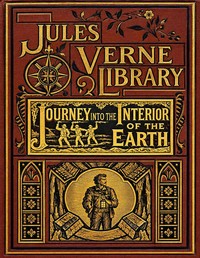
Journey to the Center of the Earth
Jules Verne, 1864
 BookFeed English
Σελίδες από το «Journey to the Center of the Earth» που στέκονται μόνες τους, διαλεγμένες για το πώς διαβάζονται σήμερα. Το κείμενο ανήκει στο κοινό κτήμα.
We had long lost sight of the sea shore behind the hills of bones. The rash Professor, careless of losing his way, hurried me forward. We advanced in silence, bathed in luminous electric fluid. By some phenomenon which I am unable to explain, it lighted up all sides of every object equally. Such was its diffusiveness, there being no central point from which the light emanated, that shadows no longer existed. You might have thought yourself under the rays of a vertical sun in a tropical region at noonday and the height of summer. No vapour was visible. The rocks, the distant mountains, a few isolated clumps of forest trees in the distance, presented a weird and wonderful aspect under these totally new conditions of a universal diffusion of light. We were like Hoffmann’s shadowless man. I opened my eyes. I saw houses squashed flat as if they had all fallen down from the skies; a smoke fog seemed to drown them. Over my head ragged clouds were drifting past, and by an optical inversion they seemed stationary, while the steeple, the ball and I were all spinning along with fantastic speed. Far away on one side was the green country, on the other the sea sparkled, bathed in sunlight. The Sound stretched away to Elsinore, dotted with a few white sails, like seagulls’ wings; and in the misty east and away to the northeast lay outstretched the faintly-shadowed shores of Sweden. All this immensity of space whirled and wavered, fluctuating beneath my eyes. The wall that confined the fjord, like all the coast of the peninsula, was composed of a series of vertical columns thirty feet high. These straight shafts, of fair proportions, supported an architrave of horizontal slabs, the overhanging portion of which formed a semi-arch over the sea. At intervals, under this natural shelter, there spread out vaulted entrances in beautiful curves, into which the waves came dashing with foam and spray. A few shafts of basalt, torn from their hold by the fury of tempests, lay along the soil like remains of an ancient temple, in ruins forever fresh, and over which centuries passed without leaving a trace of age upon them. But that which formed steps under our feet became stalactites overhead. The lava, which was porous in many places, had formed a surface covered with small rounded blisters; crystals of opaque quartz, set with limpid tears of glass, and hanging like clustered chandeliers from the vaulted roof, seemed as it were to kindle and form a sudden illumination as we passed on our way. It seemed as if the genii of the depths were lighting up their palace to receive their terrestrial guests. I therefore awoke next day relieved from the preoccupation of an immediate start. Although we were in the very deepest of known depths, there was something not unpleasant about it. And, besides, we were beginning to get accustomed to this troglodyte life. I no longer thought of sun, moon, and stars, trees, houses, and towns, nor of any of those terrestrial superfluities which are necessaries of men who live upon the earth’s surface. Being fossils, we looked upon all those things as mere jokes. At that moment the light from our lantern began to sink by little and little, and then went out entirely. The wick had burnt itself out. Black night reigned again; and there was no hope left of being able to dissipate the palpable darkness. We had yet a torch left, but we could not have kept it alight. Then, like a child, I closed my eyes firmly, not to see the darkness. As long as we were protected on the inside of the winding staircase up the tower, all was well enough; but after toiling up a hundred and fifty steps the fresh air came to salute my face, and we were on the leads of the tower. There the aerial staircase began its gyrations, only guarded by a thin iron rail, and the narrowing steps seemed to ascend into infinite space! But his habit of silence gained upon him day by day, and was infecting us. External objects produce decided effects upon the brain. A man shut up between four walls soon loses the power to associate words and ideas together. How many prisoners in solitary confinement become idiots, if not mad, for want of exercise for the thinking faculty! Often these chains of barren rocks made a dip towards the sea, and encroached upon the scanty pasturage: but there was always enough room to pass. Besides, our horses instinctively chose the easiest places without ever slackening their pace. My uncle was refused even the satisfaction of stirring up his beast with whip or voice. He had no excuse for being impatient. I could not help smiling to see so tall a man on so small a pony, and as his long legs nearly touched the ground he looked like a six-legged centaur. I had soon explored these melancholy ways; here and there I got a glimpse of faded turf, looking like a worn-out bit of carpet, or some appearance of a kitchen garden, the sparse vegetables of which (potatoes, cabbages, and lettuces), would have figured appropriately upon a Lilliputian table. A few sickly wallflowers were trying to enjoy the air and sunshine. Jules Verne, 1864
Διάβασε σελίδες από βιβλία σαν αυτό, μία τη φορά
Το BookFeed είναι μια ροή με αποσπάσματα από βιβλία. Μαθαίνει τι σου αρέσει και σε βοηθά να βρεις το επόμενο βιβλίο σου.
Άνοιξε το BookFeedΔωρεάν, χωρίς εγγραφή.