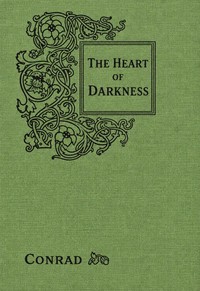
Heart of Darkness
Joseph Conrad, 1899
 BookFeed English
Σελίδες από το «Heart of Darkness» που στέκονται μόνες τους, διαλεγμένες για το πώς διαβάζονται σήμερα. Το κείμενο ανήκει στο κοινό κτήμα.
Droll thing life is—that mysterious arrangement of merciless logic for a futile purpose. The most you can hope from it is some knowledge of yourself—that comes too late—a crop of unextinguishable regrets. I have wrestled with death. It is the most unexciting contest you can imagine. It takes place in an impalpable greyness, with nothing underfoot, with nothing around, without spectators, without clamour, without glory, without the great desire of victory, without the great fear of defeat, in a sickly atmosphere of tepid scepticism, without much belief in your own right, and still less in that of your adversary. “Going up that river was like traveling back to the earliest beginnings of the world, when vegetation rioted on the earth and the big trees were kings. An empty stream, a great silence, an impenetrable forest. The air was warm, thick, heavy, sluggish. There was no joy in the brilliance of sunshine. The long stretches of the waterway ran on, deserted, into the gloom of overshadowed distances. On silvery sand-banks hippos and alligators sunned themselves side by side. The broadening waters flowed through a mob of wooded islands; you lost your way on that river as you would in a desert, and butted all day long against shoals, trying to find the channel, till you thought yourself bewitched and cut off for ever from everything you had known once—somewhere—far away—in another existence perhaps. “I went to work the next day, turning, so to speak, my back on that station. In that way only it seemed to me I could keep my hold on the redeeming facts of life. Still, one must look about sometimes; and then I saw this station, these men strolling aimlessly about in the sunshine of the yard. I asked myself sometimes what it all meant. They wandered here and there with their absurd long staves in their hands, like a lot of faithless pilgrims bewitched inside a rotten fence. The word ‘ivory’ rang in the air, was whispered, was sighed. You would think they were praying to it. A taint of imbecile rapacity blew through it all, like a whiff from some corpse. By Jove! I’ve never seen anything so unreal in my life. “Now when I was a little chap I had a passion for maps. I would look for hours at South America, or Africa, or Australia, and lose myself in all the glories of exploration. At that time there were many blank spaces on the earth, and when I saw one that looked particularly inviting on a map (but they all look that) I would put my finger on it and say, ‘When I grow up I will go there.’ The North Pole was one of these places, I remember. Well, I haven’t been there yet, and shall not try now. The glamour’s off. Other places were scattered about the hemispheres. I have been in some of them, and... well, we won’t talk about that. But there was one yet—the biggest, the most blank, so to speak—that I had a hankering after. Here you all are, each moored with two good addresses, like a hulk with two anchors, a butcher round one corner, a policeman round another, excellent appetites, and temperature normal—you hear—normal from year’s end to year’s end. And you say, Absurd! Absurd be—exploded! Absurd! My dear boys, what can you expect from a man who out of sheer nervousness had just flung overboard a pair of new shoes! Now I think of it, it is amazing I did not shed tears. I am, upon the whole, proud of my fortitude. I found myself back in the sepulchral city resenting the sight of people hurrying through the streets to filch a little money from each other, to devour their infamous cookery, to gulp their unwholesome beer, to dream their insignificant and silly dreams. They trespassed upon my thoughts. They were intruders whose knowledge of life was to me an irritating pretence, because I felt so sure they could not possibly know the things I knew. “We gave her her letters (I heard the men in that lonely ship were dying of fever at the rate of three a day) and went on. We called at some more places with farcical names, where the merry dance of death and trade goes on in a still and earthy atmosphere as of an overheated catacomb; all along the formless coast bordered by dangerous surf, as if Nature herself had tried to ward off intruders; in and out of rivers, streams of death in life, whose banks were rotting into mud, whose waters, thickened into slime, invaded the contorted mangroves, that seemed to writhe at us in the extremity of an impotent despair. Nowhere did we stop long enough to get a particularized impression, but the general sense of vague and oppressive wonder grew upon me. It was like a weary pilgrimage amongst hints for nightmares. It was an extraordinary find. Its title was, An Inquiry into some Points of Seamanship, by a man Towser, Towson—some such name—Master in his Majesty’s Navy. The matter looked dreary reading enough, with illustrative diagrams and repulsive tables of figures, and the copy was sixty years old. I handled this amazing antiquity with the greatest possible tenderness, lest it should dissolve in my hands. Within, Towson or Towser was inquiring earnestly into the breaking strain of ships’ chains and tackle, and other such matters. Not a very enthralling book; but at the first glance you could see there a singleness of intention, an honest concern for the right way of going to work, which made these humble pages, thought out so many years ago, luminous with another than a professional light. “She walked with measured steps, draped in striped and fringed cloths, treading the earth proudly, with a slight jingle and flash of barbarous ornaments. She carried her head high; her hair was done in the shape of a helmet; she had brass leggings to the knee, brass wire gauntlets to the elbow, a crimson spot on her tawny cheek, innumerable necklaces of glass beads on her neck; bizarre things, charms, gifts of witch-men, that hung about her, glittered and trembled at every step. She must have had the value of several elephant tusks upon her. She was savage and superb, wild-eyed and magnificent; there was something ominous and stately in her deliberate progress. Joseph Conrad, 1899
Διάβασε σελίδες από βιβλία σαν αυτό, μία τη φορά
Το BookFeed είναι μια ροή με αποσπάσματα από βιβλία. Μαθαίνει τι σου αρέσει και σε βοηθά να βρεις το επόμενο βιβλίο σου.
Άνοιξε το BookFeedΔωρεάν, χωρίς εγγραφή.