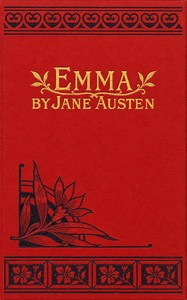
Emma
Jane Austen, 1815
 BookFeed English
Σελίδες από το «Emma» που στέκονται μόνες τους, διαλεγμένες για το πώς διαβάζονται σήμερα. Το κείμενο ανήκει στο κοινό κτήμα.
Seldom, very seldom, does complete truth belong to any human disclosure; seldom can it happen that something is not a little disguised, or a little mistaken; but where, as in this case, though the conduct is mistaken, the feelings are not, it may not be very material.—Mr. Knightley could not impute to Emma a more relenting heart than she possessed, or a heart more disposed to accept of his. It was felt as such things must be felt. Everybody had a degree of gravity and sorrow; tenderness towards the departed, solicitude for the surviving friends; and, in a reasonable time, curiosity to know where she would be buried. Goldsmith tells us, that when lovely woman stoops to folly, she has nothing to do but to die; and when she stoops to be disagreeable, it is equally to be recommended as a clearer of ill-fame. Mrs. Churchill, after being disliked at least twenty-five years, was now spoken of with compassionate allowances. In one point she was fully justified. She had never been admitted before to be seriously ill. The event acquitted her of all the fancifulness, and all the selfishness of imaginary complaints. Her own conduct, as well as her own heart, was before her in the same few minutes. She saw it all with a clearness which had never blessed her before. How improperly had she been acting by Harriet! How inconsiderate, how indelicate, how irrational, how unfeeling had been her conduct! What blindness, what madness, had led her on! It struck her with dreadful force, and she was ready to give it every bad name in the world. Such an adventure as this—a fine young man and a lovely young woman thrown together in such a way, could hardly fail of suggesting certain ideas to the coldest heart and the steadiest brain. So Emma thought, at least. Could a linguist, could a grammarian, could even a mathematician have seen what she did, have witnessed their appearance together, and heard their history of it, without feeling that circumstances had been at work to make them peculiarly interesting to each other?—How much more must an imaginist, like herself, be on fire with speculation and foresight!—especially with such a groundwork of anticipation as her mind had already made. Mrs. Bates, the widow of a former vicar of Highbury, was a very old lady, almost past everything but tea and quadrille. She lived with her single daughter in a very small way, and was considered with all the regard and respect which a harmless old lady, under such untoward circumstances, can excite. Her daughter enjoyed a most uncommon degree of popularity for a woman neither young, handsome, rich, nor married. Miss Bates stood in the very worst predicament in the world for having much of the public favour; and she had no intellectual superiority to make atonement to herself, or frighten those who might hate her into outward respect. She had never boasted either beauty or cleverness. It may be possible to do without dancing entirely. Instances have been known of young people passing many, many months successively, without being at any ball of any description, and no material injury accrue either to body or mind;—but when a beginning is made—when the felicities of rapid motion have once been, though slightly, felt—it must be a very heavy set that does not ask for more. Mrs. Weston was exceedingly disappointed—much more disappointed, in fact, than her husband, though her dependence on seeing the young man had been so much more sober: but a sanguine temper, though forever expecting more good than occurs, does not always pay for its hopes by any proportionate depression. It soon flies over the present failure, and begins to hope again. For half an hour Mr. Weston was surprised and sorry; but then he began to perceive that Frank’s coming two or three months later would be a much better plan; better time of year; better weather; and that he would be able, without any doubt, to stay considerably longer with them than if he had come sooner. Upon such occasions poor Mr. Woodhouse’s feelings were in sad warfare. He loved to have the cloth laid, because it had been the fashion of his youth, but his conviction of suppers being very unwholesome made him rather sorry to see anything put on it; and while his hospitality would have welcomed his visitors to everything, his care for their health made him grieve that they would eat. Her views of improving her little friend’s mind, by a great deal of useful reading and conversation, had never yet led to more than a few first chapters, and the intention of going on tomorrow. It was much easier to chat than to study; much pleasanter to let her imagination range and work at Harriet’s fortune, than to be labouring to enlarge her comprehension or exercise it on sober facts; and the only literary pursuit which engaged Harriet at present, the only mental provision she was making for the evening of life, was the collecting and transcribing all the riddles of every sort that she could meet with, into a thin quarto of hot-pressed paper, made up by her friend, and ornamented with ciphers and trophies. Jane Austen, 1815
Διάβασε σελίδες από βιβλία σαν αυτό, μία τη φορά
Το BookFeed είναι μια ροή με αποσπάσματα από βιβλία. Μαθαίνει τι σου αρέσει και σε βοηθά να βρεις το επόμενο βιβλίο σου.
Άνοιξε το BookFeedΔωρεάν, χωρίς εγγραφή.