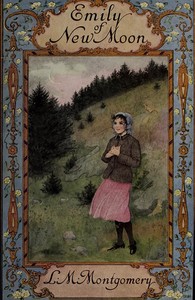
Έμιλι του Νιου Μουν
L. M. Montgomery, 1923
Η ορφανή Έμιλι, με ένα κοντό μολύβι και έναν ακατάβλητο εσωτερικό κόσμο, στέλνεται να ζήσει με αυστηρούς συγγενείς στο Νησί του Πρίγκιπα Εδουάρδου και αρχίζει να τους καταγράφει όλους.
 BookFeed English
Σελίδες από το «Έμιλι του Νιου Μουν» που στέκονται μόνες τους, διαλεγμένες για το πώς διαβάζονται σήμερα. Το κείμενο ανήκει στο κοινό κτήμα.
Το σπίτι που έμεινε μισοτελειωμένο και το τελειώνει η Έμιλι με τη φαντασία της.
Off to the right, on the crest of a steep little hill, covered with young birches and firs, was a house that puzzled and intrigued Emily. It was grey and weatherworn, but it didn’t look old. It had never been finished; the roof was shingled but the sides were not, and the windows were boarded over. Why had it never been finished? And it was meant to be such a pretty little house—a house you could love—a house where there would be nice chairs and cozy fires and bookcases and lovely, fat, purry cats and unexpected corners; then and there she named it the Disappointed House, and many an hour thereafter did she spend finishing that house, furnishing it as it should be furnished, and inventing the proper people and animals to live in it. Η μέρα που ο κόσμος μένει όμορφος, αλλά παύει να έχει σημασία.
“There isn’t anybody in the world who loves me now,” she said, as she curled up on her bed by the window. But she was determined she would not cry. The Murrays, who had hated her father, should not see her crying. She felt that she detested them all—except perhaps Aunt Laura. How very big and empty the world had suddenly become. Nothing was interesting any more. It did not matter that the little squat apple-tree between Adam-and-Eve had become a thing of rose-and-snow beauty—that the hills beyond the hollow were of green silk, purple-misted—that the daffodils were out in the garden—that the birches were hung all over with golden tassels—that the Wind Woman was blowing white young clouds across the sky. None of these things had any charm or consolation for her now. In her inexperience she believed they never would have again. Μια λέξη για κάτι που δεν έχει φτάσει ακόμη στα λεξικά.
“Mike II is here with me, sitting on the windowsill. Mike is a smee cat. Smee is not in the dictionary. It is a word I invented myself. I could not think of any English word which just describes Mike II so I made this up. It means sleek and glossy and soft and fluffy all in one and something else besides that I cant express. Το γράψιμο γίνεται το καταφύγιο της Έμιλι.
For a moment she thought she would throw herself on her bed and cry. She couldn’t bear all the pain and shame that were burning in her heart. Then her eyes fell on the old yellow account book on her little table. A minute later Emily was curled up on her bed, Turk-fashion, writing eagerly in the old book with her little stubby lead pencil. As her fingers flew over the faded lines her cheeks flushed and her eyes shone. Κάποια παιδιά βλέπουν κάτι και αμέσως βρίσκουν τις λέξεις του.
She scuttled back to the house in the hollow, through the gathering twilight, all agog to get home and write down her “description” before the memory picture of what she had seen grew a little blurred. She knew just how she would begin it—the sentence seemed to shape itself in her mind: “The hill called to me and something in me called back to it.” Μερικοί καταλαβαίνουν τα συναισθήματα μόνο όταν τους τα εξηγήσεις.
Aunt Elizabeth considered for a moment. She couldn’t understand why anybody should want a cat. Aunt Elizabeth was one of those people who never do understand anything unless it is told them in plain language and hammered into their heads. And then they understand it only with their brains and not with their hearts. Κάποια στιγμή, το έργο για το οποίο καμάρωνες μοιάζει να ανήκει σε άλλον.
This sort of thing was happening frequently now. Every time she read her little hoard of manuscripts over she found some of which the fairy gold had unaccountably turned to withered leaves, fit only for the burning. Emily burned them—but it hurt her a little. Outgrowing things we love is never a pleasant process. Δυο λέξεις σε μια ταφόπλακα, χωρίς ψαλμό από κάτω.
Emily ran curiously over. The big flat stone was inscribed with one of the long, discursive epitaphs of an older day. But beneath the epitaph was no scriptural verse or pious psalm. Clear and distinct, in spite of age and lichen, ran the line, “Here I stay.” Η Έμιλι ετοιμάζεται να εκδικηθεί, αλλά κάτι την κάνει να κοντοσταθεί.
“Rhoda Stuart made fun of Ilse and me but I heaped coals of fire on her head. (That is what is called a figure of speech.) She got stuck in her recitation. She had left the book home and nobody else knew the piece but me. At first I looked at her triumphantly. But then a queer feeling came into me and I thought ‘What would I feel like if I was stuck before a big crowd of people like this? And besides the honour of the school is at stake,’ so I whispered it to her because I was quite close. She got through the rest all right. The strange thing is, dear Father, that now I don’t feel any more as if I hated her. I feel quite kindly to her and it is much nicer. It is uncomfortable to hate people. L. M. Montgomery, 1923
Η ορφανή Έμιλι, με ένα κοντό μολύβι και έναν ακατάβλητο εσωτερικό κόσμο, στέλνεται να ζήσει με αυστηρούς συγγενείς στο Νησί του Πρίγκιπα Εδουάρδου και αρχίζει να τους καταγράφει όλους.
Διάβασε σελίδες από βιβλία σαν αυτό, μία τη φορά
Το BookFeed είναι μια ροή με αποσπάσματα από βιβλία. Μαθαίνει τι σου αρέσει και σε βοηθά να βρεις το επόμενο βιβλίο σου.
Άνοιξε το BookFeedΔωρεάν, χωρίς εγγραφή.