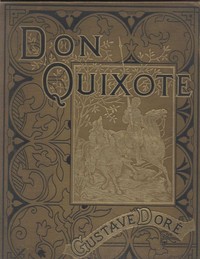
Don Quixote
Miguel de Cervantes Saavedra, 1605
 BookFeed English
Σελίδες από το «Don Quixote» που στέκονται μόνες τους, διαλεγμένες για το πώς διαβάζονται σήμερα. Το κείμενο ανήκει στο κοινό κτήμα.
Then the love-thoughts of the heart clothed themselves simply and naturally as the heart conceived them, nor sought to commend themselves by forced and rambling verbiage. Fraud, deceit, or malice had then not yet mingled with truth and sincerity. Justice held her ground, undisturbed and unassailed by the efforts of favour and of interest, that now so much impair, pervert, and beset her. Arbitrary law had not yet established itself in the mind of the judge, for then there was no cause to judge and no one to be judged. Maidens and modesty, as I have said, wandered at will alone and unattended, without fear of insult from lawlessness or libertine assault, and if they were undone it was of their own will and pleasure. Continuing his discourse Don Quixote said: “As we began in the student’s case with poverty and its accompaniments, let us see now if the soldier is richer, and we shall find that in poverty itself there is no one poorer; for he is dependent on his miserable pay, which comes late or never, or else on what he can plunder, seriously imperilling his life and conscience; and sometimes his nakedness will be so great that a slashed doublet serves him for uniform and shirt, and in the depth of winter he has to defend himself against the inclemency of the weather in the open field with nothing better than the breath of his mouth, which I need not say, coming from an empty place, must come out cold, contrary to the laws of nature. And if this seems a trifling risk, let us see whether it is equalled or surpassed by the encounter of two galleys stem to stem, in the midst of the open sea, locked and entangled one with the other, when the soldier has no more standing room than two feet of the plank of the spur; and yet, though he sees before him threatening him as many ministers of death as there are cannon of the foe pointed at him, not a lance length from his body, and sees too that with the first heedless step he will go down to visit the profundities of Neptune’s bosom, still with dauntless heart, urged on by honour that nerves him, he makes himself a target for all that musketry, and struggles to cross that narrow path to the enemy’s ship. And you must know besides, that the true knight-errant, though he may see ten giants, that not only touch the clouds with their heads but pierce them, and that go, each of them, on two tall towers by way of legs, and whose arms are like the masts of mighty ships, and each eye like a great mill-wheel, and glowing brighter than a glass furnace, must not on any account be dismayed by them. On the contrary, he must attack and fall upon them with a gallant bearing and a fearless heart, and, if possible, vanquish and destroy them, even though they have for armour the shells of a certain fish, that they say are harder than diamonds, and in place of swords wield trenchant blades of Damascus steel, or clubs studded with spikes also of steel, such as I have more than once seen. I would do a great deal better (if I was not an ignorant brute that will never do any good all my life), I would do a great deal better, I say, to go home to my wife and children and support them and bring them up on what God may please to give me, instead of following your worship along roads that lead nowhere and paths that are none at all, with little to drink and less to eat. And then when it comes to sleeping! Measure out seven feet on the earth, brother squire, and if that’s not enough for you, take as many more, for you may have it all your own way and stretch yourself to your heart’s content. “Bear in mind that the culprit who comes under thy jurisdiction is but a miserable man subject to all the propensities of our depraved nature, and so far as may be in thy power show thyself lenient and forbearing; for though the attributes of God are all equal, to our eyes that of mercy is brighter and loftier than that of justice. Straightway it will come to pass that she will fix her eyes upon the knight and he his upon her, and each will seem to the other something more divine than human, and, without knowing how or why they will be taken and entangled in the inextricable toils of love, and sorely distressed in their hearts not to see any way of making their pains and sufferings known by speech. Thence they will lead him, no doubt, to some richly adorned chamber of the palace, where, having removed his armour, they will bring him a rich mantle of scarlet wherewith to robe himself, and if he looked noble in his armour he will look still more so in a doublet. “Keep to your own station, Sancho,” replied Teresa; “don’t try to raise yourself higher, and bear in mind the proverb that says, ‘wipe the nose of your neighbour’s son, and take him into your house.’ A fine thing it would be, indeed, to marry our Maria to some great count or grand gentleman, who, when the humour took him, would abuse her and call her clown-bred and clodhopper’s daughter and spinning wench. I have not been bringing up my daughter for that all this time, I can tell you, husband. “That is true,” said Don Quixote, “for it would not be right that the accessories of the drama should be real, instead of being mere fictions and semblances, like the drama itself; towards which, Sancho—and, as a necessary consequence, towards those who represent and produce it—I would that thou wert favourably disposed, for they are all instruments of great good to the State, placing before us at every step a mirror in which we may see vividly displayed what goes on in human life; nor is there any similitude that shows us more faithfully what we are and ought to be than the play and the players. Come, tell me, hast thou not seen a play acted in which kings, emperors, pontiffs, knights, ladies, and divers other personages were introduced? All this long harangue (which might very well have been spared) our knight delivered because the acorns they gave him reminded him of the golden age; and the whim seized him to address all this unnecessary argument to the goatherds, who listened to him gaping in amazement without saying a word in reply. Sancho likewise held his peace and ate acorns, and paid repeated visits to the second wineskin, which they had hung up on a cork tree to keep the wine cool. Miguel de Cervantes Saavedra, 1605
Διάβασε σελίδες από βιβλία σαν αυτό, μία τη φορά
Το BookFeed είναι μια ροή με αποσπάσματα από βιβλία. Μαθαίνει τι σου αρέσει και σε βοηθά να βρεις το επόμενο βιβλίο σου.
Άνοιξε το BookFeedΔωρεάν, χωρίς εγγραφή.